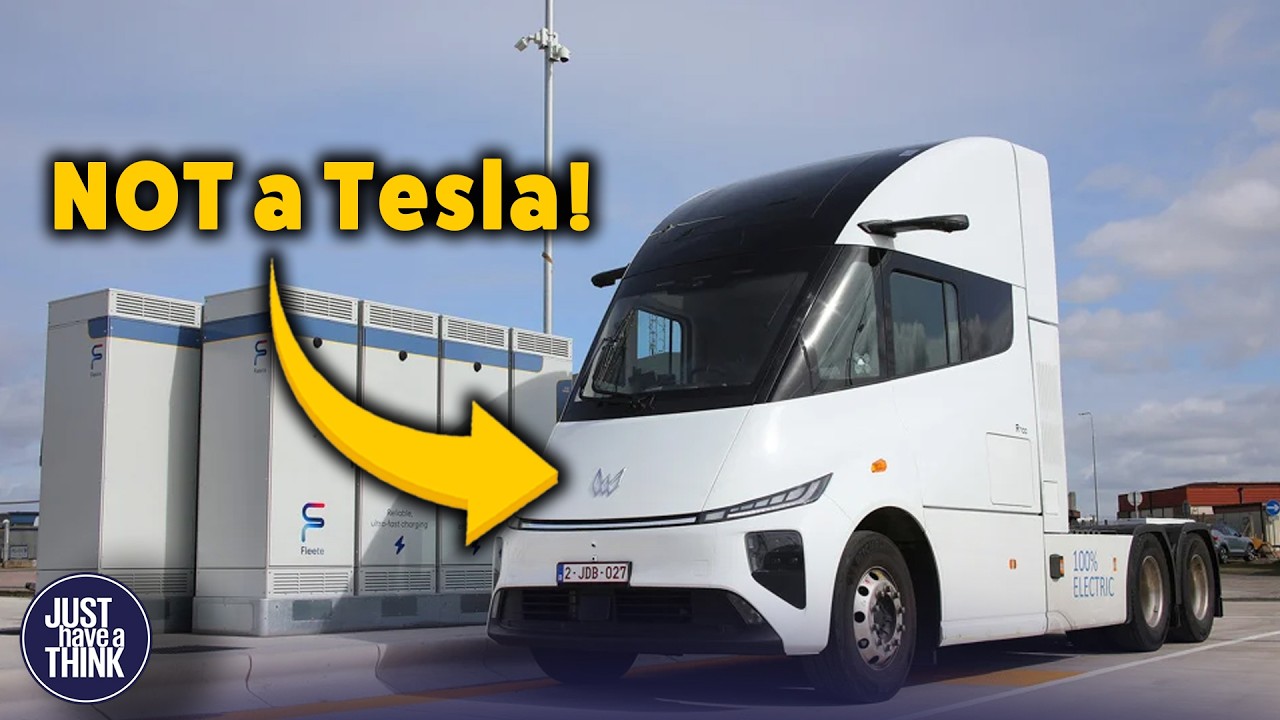
Whatever happened to the Tesla Semi? And does its slow rollout mean electric trucks aren’t viable? According to the International Energy Agency’s Global EV Outlook 2025, the answer may be very different from what you might think. Because while much of the Western conversation is focused on delays and limited deployments, China is already electrifying heavy freight at scale, with electric trucks reaching 50% of new sales and beginning to challenge assumptions about diesel dominance. So, what could it all mean for the future of oil demand and the energy transition?
Help support this channel's independence at
http://www.patreon.com/justhaveathink
Or with a donation via Paypal by clicking here
https://www.paypal.com/cgi-bin/webscr?cmd=_s-xclick&hosted_button_id=GWR73EHXGJMAE&source=url
You can also help keep my brain ticking over during the long hours of research and editing via the nice folks at BuyMeACoffee.com
https://www.buymeacoffee.com/justhaveathink
Get your tickets for the Everything Electric NORTH show here
https://tickets.lupevents.co.uk/everything-electric-north?cat=CAT-REGISTRATION
Reference Links
IEA Global EV Outlook 2025
https://iea.blob.core.windows.net/assets/7ea38b60-3033-42a6-9589-71134f4229f4/GlobalEVOutlook2025.pdf
Everything Electric podcast with Windrose CEO
https://www.youtube.com/watch?v=Hxg-c7uEeis
Additional reading on electrified freight :-
Reuters - Soaring electric truck sales deal new blow to diesel use in China
https://www.reuters.com/sustainability/climate-energy/soaring-electric-truck-sales-deal-new-blow-diesel-use-china-2025-07-11
Smart Freight Centre China
https://smart-freight-centre-media.s3.amazonaws.com/documents/2024_ZEFI_Shenzhen-Dongguan-Huizhou.pdf
Green Energy and Intelligent Transport - Yu et al
https://pdf.sciencedirectassets.com/781840/1-s2.0-S2773153725X00086/1-s2.0-S2773153725000453/main.pdf
Electrifying on-road freight - ICCT
https://theicct.org/wp-content/uploads/2026/01/ID-455-%E2%80%93-Yangtze-freight_working-paper_final.pdf
Interesting Engineering article
https://interestingengineering.com/transportation/china-electric-trucks-cut-emissions
Check out other YouTube Climate Communicators
Simon Clark:
youtube.com/user/SimonOxfPhys
ClimateTown:
youtube.com/channel/UCuVLG9pThvBABcYCm7pkNkA
Dr Gilbz
youtube.com/@DrGilbz
zentouro:
youtube.com/user/zentouro
Climate Adam:
youtube.com/user/ClimateAdam
Kurtis Baute:
youtube.com/user/ScopeofScience
Sarah Karvner:
youtube.com/channel/UCRwMkTu8sCwOOD6_7QYrZnw
Beckisphere: https://www.youtube.com/channel/UCT39HQq5eDKonaUV8ujiBCQ
Our Changing Climate :
https://www.youtube.com/channel/UCNXvxXpDJXp-mZu3pFMzYHQ
Оглавление (3 сегментов)
Segment 1 (00:00 - 05:00)
A few years ago, the electrification of heavy trucks briefly captured the public imagination when Elon Musk announced the Tesla Semi with the usual fanfare associated with most of his new ideas. When it was first unveiled in 2017, the vehicle was presented as a technological breakthrough that would transform long-haul freight. Elon claimed ranges of up to 500 miles, rapid charging using Tesla's planned Megacharger network, and dramatically lower operating costs compared to existing diesel trucks. And for a brief moment, it looked like the transition might happen almost overnight. Major logistics companies placed reservations. Headlines suggested that electric trucks might soon dominate freight transport. And then things went a bit quiet, didn't they? Tesla's Semi eventually did enter limited production years later, but only in relatively small numbers. The large-scale rollout that many people expected never really materialized. So, what happened? Well, I think we all know what happened to Elon, but what happened to the whole electric truck global dominance thing? Did it collide with the harsh realities of physics and economics? After all, freight trucks are large, heavy machines that travel long distances and operate almost continuously. Batteries are heavy, charging infrastructure is expensive, and downtime for freight vehicles can be extremely costly. For some observers, the slow progress of projects like the Tesla Semi appeared to confirm their original skepticism. "Perhaps electrification only works for passenger cars and city buses," they mused. "Maybe heavy goods vehicles are destined to remain diesel-powered for the foreseeable future. " And that skeptical assertion was, of course, a load of box. Because while much of the Western conversation about electric trucks has focused on a handful of high-profile projects, in another part of the world, I bet you can't guess where, electrification of heavy freight is already happening at scale. And the transition is happening so quickly that analysts are now starting to ask whether electric trucks could soon begin to disrupt global diesel demand. So, we should have a think about that, shouldn't we? Hello, and welcome to Just Have a Think. For years, there's been this persistent argument about heavy-duty electric vehicles that they'd be among the last holdouts of the fossil fuel industry. But according to the International Energy Agency's Global EV Outlook 2025, that assumption may already be breaking down. Before we get stuck into all that, though, I'm delighted to let you know that I will once again be hosting several discussion panels at the upcoming Everything Electric Live Show up in Harrogate on Friday the 8th and Saturday the 9th of May. There's all the usual brilliant stuff like test drives of all the latest electric vehicles, of which there are now, of course, about a gazillion to choose from, plus a whole arena full of experts to guide you through the process of choosing heat pumps, solar panels, battery energy systems, car chargers, and just about everything else you might be looking for to transform your home as part of the global energy transition. There's plenty of outdoor space, too, with great food zones and space for the kids to run around and have a bit of fun. A daily ticket costs £10, or you can get a two-day ticket for £15. Plus, if you use my Just Have a Think discount code at the bottom of the screen, then you'll get 20% off those prices. What's not to like? So, scan the QR code or follow the link in the description section to grab your tickets while they're still available, and I'll hopefully see you there. So, as I'm sure you know, every year the IEA publishes this document, which tracks electrification across the transport sector. Unsurprisingly, most of the focus is on passenger cars, but the 2025 edition also contains a striking update on heavy-duty vehicles like trucks and buses. According to the IEA, electric bus sales reached more than 70,000 units in 2024, increasing by roughly 30% year on year. Electric truck sales are also rising quickly, but the most important part of the story is where those trucks are being deployed. More than 80% of global electric truck sales are currently happening in China. Freight transport has traditionally been one of the most reliable drivers of oil demand growth. Heavy trucks consume vast quantities of diesel. In most industrial economies, they account for a disproportionately large share of road transport emissions. So, if electric trucks begin replacing diesel trucks at scale, the implications extend far beyond the transport sector. According to data cited by analysts and industry reports, electric heavy trucks reached around 22% of new truck sales in China during the first half of 2025. In December 2025, electric trucks reportedly crossed 50% of new sales in China for that month. Obviously, monthly data can fluctuate
Segment 2 (05:00 - 10:00)
but that's quite a striking statistic, don't you think? The long-term trend will be clearer over the next few years, but the direction of travel is pretty unmistakable. The electrification of heavy freight is no longer confined to pilot projects or demonstration fleets. It's becoming a real industrial market. So, why does it always seem to be China leading the way on this sort of thing? Well, it looks like several factors are converging, probably the most obvious of which is economics. Electric trucks still cost significantly more in upfront purchase costs compared to diesel equivalents, but according to this 2025 study, total operating costs for electric trucks are much lower than both diesel and hydrogen fuel cell competitors. Electric drivetrains have fewer moving parts, electricity itself is frequently cheaper than diesel, and high-utilization vehicles like logistics trucks operating predictable routes can recover the higher capital cost relatively quickly. And as we've seen in previous videos in this channel, China's achieved lower battery cost than most other regions, largely because it dominates the global battery manufacturing supply chain. Then there's infrastructure strategy. Instead of trying to electrify every trucking route simultaneously, China's focused on high-volume freight corridors, logistics hubs, and industrial routes. Many electric trucks operate between fixed depots, ports, warehouses, and industrial zones where charging infrastructure can be concentrated. Some fleets are also experimenting with battery swapping, allowing trucks to exchange depleted battery packs for fully charged ones in a matter of minutes. The world's largest battery maker, CATL, launched a time-saving battery swapping system for heavy trucks in May 2025, and it reckons it's planning a nationwide network of swap stations covering 150,000 of China's 184,000 km of expressways. How's that for ambition? It's a pragmatic engineering mindset that typifies many of China's enormous infrastructure projects, and perhaps it's a reflection of the fact that Xi Jinping himself is an engineer by profession. That pragmatism is backed up by industrial policy. China's government has supported electrification through subsidies, regulatory incentives, and local procurement policies. But perhaps as important is the fact that domestic truck manufacturers, including BYD, FAW, and Sany, have all embraced electrification as a strategic opportunity, and increasingly they're beginning to export those vehicles to other markets as well. There's really nothing in what I've just described that isn't perfectly achievable for democratic Western nations. The harsh reality is that we just didn't really bother until China started kicking our asses and waking us up. It is finally starting to happen, though. According to the IEA, Europe sold more than 10,000 electric trucks in 2024, marking the second consecutive year at that level. Electric trucks still represent a small share of total sales across the continent, but the trend is clearly upward. Much of Europe's early adoption has been driven by fleet operators. Perhaps learning from the Chinese model, large logistics companies are also deploying electric trucks on fixed routes where charging infrastructure can be installed at depots. And the region's major manufacturers are now releasing purpose-built electric models. Volvo Trucks, for example, has delivered thousands of battery electric trucks globally and has introduced long-distance electric models capable of ranges approaching 600 km with high-power charging. Meanwhile, Daimler Truck has begun series production of its eActros 600, one of the first electric heavy trucks designed specifically for long-haul freight. The vehicles are still relatively expensive to buy, and infrastructure remains limited, but they represent a clear shift in strategy among the industry's largest manufacturers. So, the question is no longer whether electric trucks are technically feasible, the question is really how quickly can they scale? Even across the pond in the good old USA, where Elon first showed off his Semi, if you'll forgive the unfortunate terminology, we are seeing growth. term We need to rewrite this bit. Even in the United States of America, according to the IEA, more than 1,700 electric vehicles were sold in 2024. That's not a big dent in the US market, in all honesty. It equates to about 0. 6% of total sales, and it's miles below Chinese volumes. Federal support for zero-emissions trucks in the United States has also become uncertain. Programs created under the Inflation Reduction Act initially provided about a billion dollars in grants to help fleets replace diesel trucks and install charging infrastructure, but since 2025, the Trump administration has paused, canceled, or clawed back portions of federal climate funding, leaving the future of these programs unclear. India is an interesting one though.
Segment 3 (10:00 - 13:00)
Modi's government recently introduced policy incentives under something called the PME Drive Scheme, aimed specifically at encouraging electric truck deployment. India's freight sector is enormous, and if electrification begins to scale there as well as China, then the global implications could really be quite significant indeed. The other very important shift is what's happening on the manufacturing side. Historically, heavy truck production has been dominated by a relatively small group of established manufacturers in Europe, North America, and Japan. But just like the electric passenger vehicle revolution, the transition to heavy-duty electric drivetrains is opening the door for new entrants, like the Chinese company Windrose for example. They're developing long-range electric trucks aimed specifically at international markets with a flagship model designed for long-haul freight ranges approaching 700 km per charge, putting it directly into competition with conventional diesel trucks on many routes. The company's raised significant funding, and it's pursuing manufacturing capacity outside China with the goal of serving European and North American markets. What makes Windrose notable is not just the technology, it's the business model. Instead of treating electric trucks as a niche product for early adopters, Windrose is attempting to compete directly on economics with traditional diesel trucks. If they succeed, and maybe drag a few other similar manufacturers along with them, then the competitive dynamics of the trucking industry could change quite rapidly, which would be nice, wouldn't it? Because although traditional fossil fuel-powered heavy trucks and buses make up only about 4% of vehicles on the roads worldwide, they generate roughly 45% of nitrogen oxide pollution and almost 60% of fine particulate emissions from road transport. And by the way, you can watch a fascinating conversation between the CEO of Windrose, Wen Han, and the ever brilliant Imogen Poole from the Everything Electric channel by clicking the link at the top of the screen, or by following the link in the description section below. Now, of course, I shouldn't get too far ahead of my skis here. Globally, diesel trucks still dominate freight transport by an overwhelming margin. Infrastructure challenges are not insignificant. Battery costs, vehicle weight, and charging networks will all influence how quickly adoption can scale. But the key point being made by the IEA's analysis is that the suggestion by fossil fuel incumbents that heavy freight electrification lies decades in the future is increasingly looking a bit silly. Now, I'm sure you've got your own views on this one. Maybe you're a trucker, and you've had a chance to drive one of these heavy-duty electric vehicles. If you have, then it'd be great to hear your feedback. And if you just want to express your opinion, then as always, the place to leave your thoughts is in the comments section below. That's it for this week though. A huge thank you, as always, to the fabulous people over at Patreon who help keep this channel free of all ads and sponsorship messages. You can join them and get early access to all my videos, watch my exclusive monthly news updates, vote in monthly content polls, and of course chat directly with me by visiting patreon. com/justhaveathink. Don't forget to like and subscribe if you found this video useful, and most importantly of all, thanks very much for watching. Have a great week, and remember to just have a think. See you next week.