Let's Invent a Math Trick Together
Machine-readable: Markdown · JSON API · Site index
Описание видео
Let's build a math trick from scratch.
Check out the channel! @polymathematic
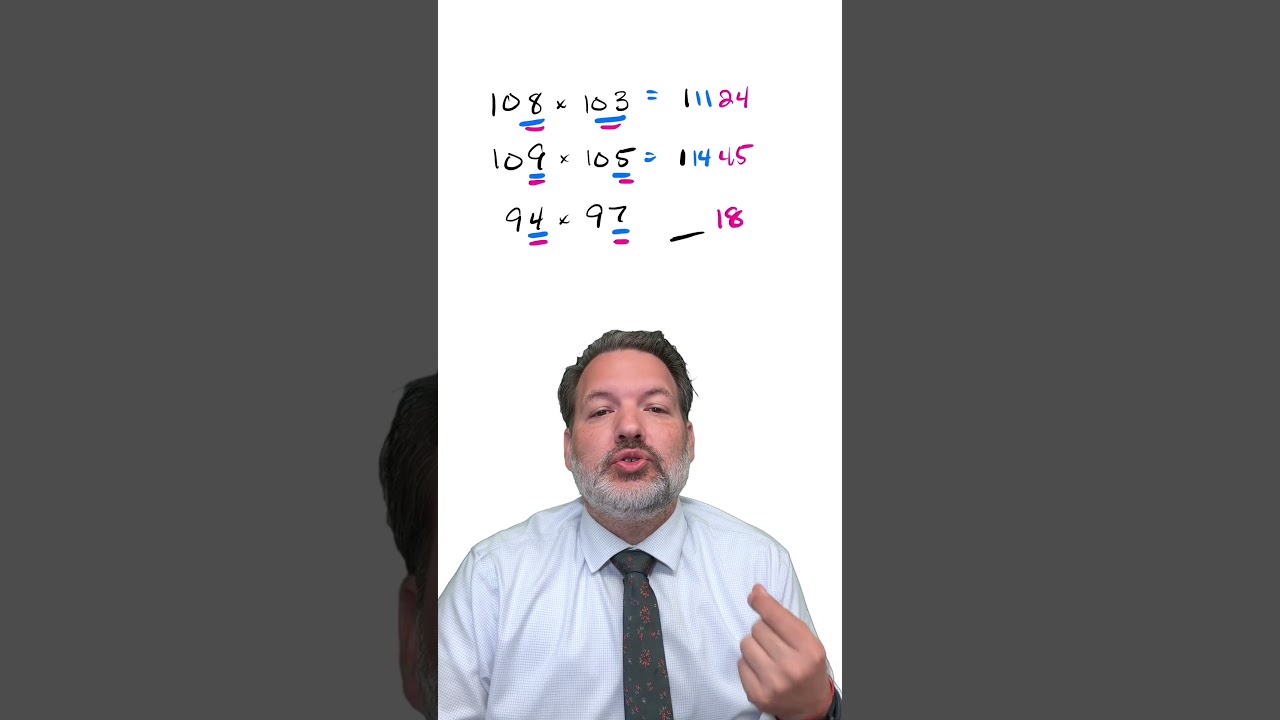
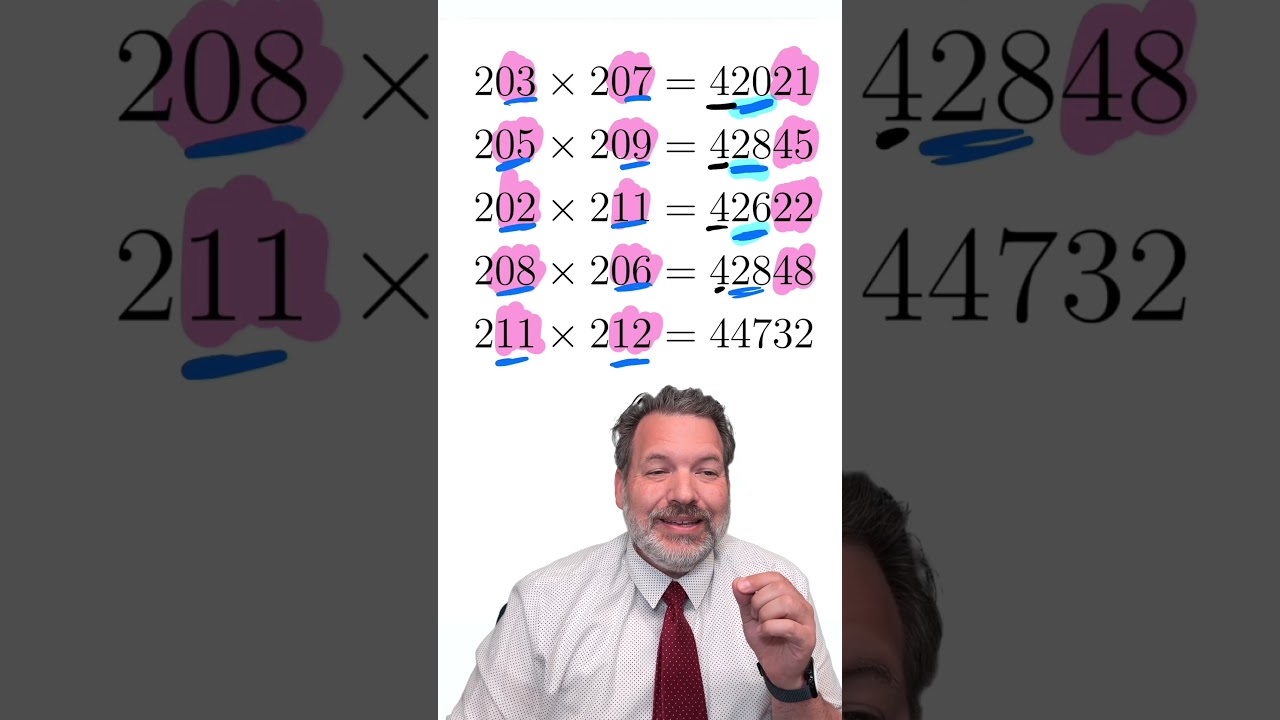
Start with a column of products of numbers just above 200 and stare at them for a minute. The first thing worth noticing isn't the answer. It's how far each factor is from 200. For 203 × 207, the "extras" are 3 and 7. For 205 × 209, they're 5 and 9. For 202 × 211, they're 2 and 11. And so on.
Now glance at the actual products. 203 × 207 ends in 21. Hmm. 3 × 7 = 21. 205 × 209 ends in 45, and 5 × 9 = 45. 202 × 211 ends in 22; 2 × 11 = 22. 208 × 206 ends in 48; 8 × 6 = 48. The last two digits of these products are just the product of the two extras. We've got half a trick already.
Keep looking. The middle of each answer wobbles a little. 200 × 200 is 40,000, so all of these products live a little above 40,000. How much above? Take the extras again — 3 and 7 — add them to get 10, and then double it to get 20. Sure enough, 203 × 207 is 42,021. Try 205 × 209: extras 5 and 9 sum to 14, double to 28, and the product is 42,845. Try 202 × 211: extras sum to 13, double to 26, and the product is 42,622.
Why the doubling? Because the base is 200, not 100. When you write 203 as 200 + 3 and 207 as 200 + 7 and you multiply (200 + 3)(200 + 7), the partial products are 200 × 200 = 40,000, plus 200 × 7 = 1,400, plus 200 × 3 = 600, plus 3 × 7 = 21. Add the two cross-terms: 1,400 + 600 = 2,000. That 2,000 is exactly 200 × (3 + 7), and dividing it into the "thousands" place of the answer is the same as taking (3 + 7), doubling it (because 200 = 2 × 100), and writing it in the hundreds-and-thousands column.
Now the interesting part: the trick breaks for 211 × 212, and the way it breaks tells us something. The extras are 11 and 12. Their product is 132, not just 32. So the last two digits should be 32, but we have an extra 100 floating around. Add 11 and 12 to get 23, double to get 46, drop on top of 40,000, and the actual answer is one bigger, because that extra 100 from 11 × 12 has to be carried into the hundreds place. The "trick" hasn't failed; it's revealing the deeper structure. The cross-term and the product-of-extras live in overlapping place values when the extras are big enough, and you carry the overflow the same way you carry in any other multi-digit multiplication.
That's the part worth keeping. A mental math shortcut is satisfying when it's fast, but it's actually useful when it points at the algebra running underneath it. (200 + a)(200 + b) = 40,000 + 200(a + b) + ab. That single line explains the whole pattern. You could invent similar tricks for numbers near 300, near 50, near 1,000, anywhere there's a clean anchor, by following the same recipe. Pick a base, notice the partial products, watch what stays put and what overlaps. Multiplication tricks that look like magic on the surface are almost always reformulations of (a + b)(c + d) underneath.
#mentalmath #multiplicationtrick #numbersense
Watch more Math Videos:
Math Minis: https://www.youtube.com/playlist?list=PLrc8spN1b3jkQynJ5heNvSs72gCPj_hwj
Math Minutes: https://www.youtube.com/playlist?list=PLrc8spN1b3jmVFYwHiuMzCYJ0y_yiwUge
Number Sense: https://www.youtube.com/playlist?list=PLrc8spN1b3jksKkY_oarNFEFAHjrIV97U
MATHCOUNTS: https://www.youtube.com/playlist?list=PLrc8spN1b3jlqDkZXtby9lnEaOBy7-ZY0
Follow Tim Ricchuiti:
TikTok: https://www.tiktok.com/@polymathematic
Mathstodon: https://mathstodon.xyz/@polymathematic
Instagram: https://www.instagram.com/polymathematicnet
Reddit: https://www.reddit.com/user/polymath-matic
Facebook: https://www.facebook.com/polymathematic