Multiply Two Numbers Near 100 Faster Than Your Calculator
Machine-readable: Markdown · JSON API · Site index
Описание видео
If you like the math in today's video, I'd love for you to check out my new number sense app! Build up your number sense a day at a time: https://studio.com/apps/polymathematic/numbersense.
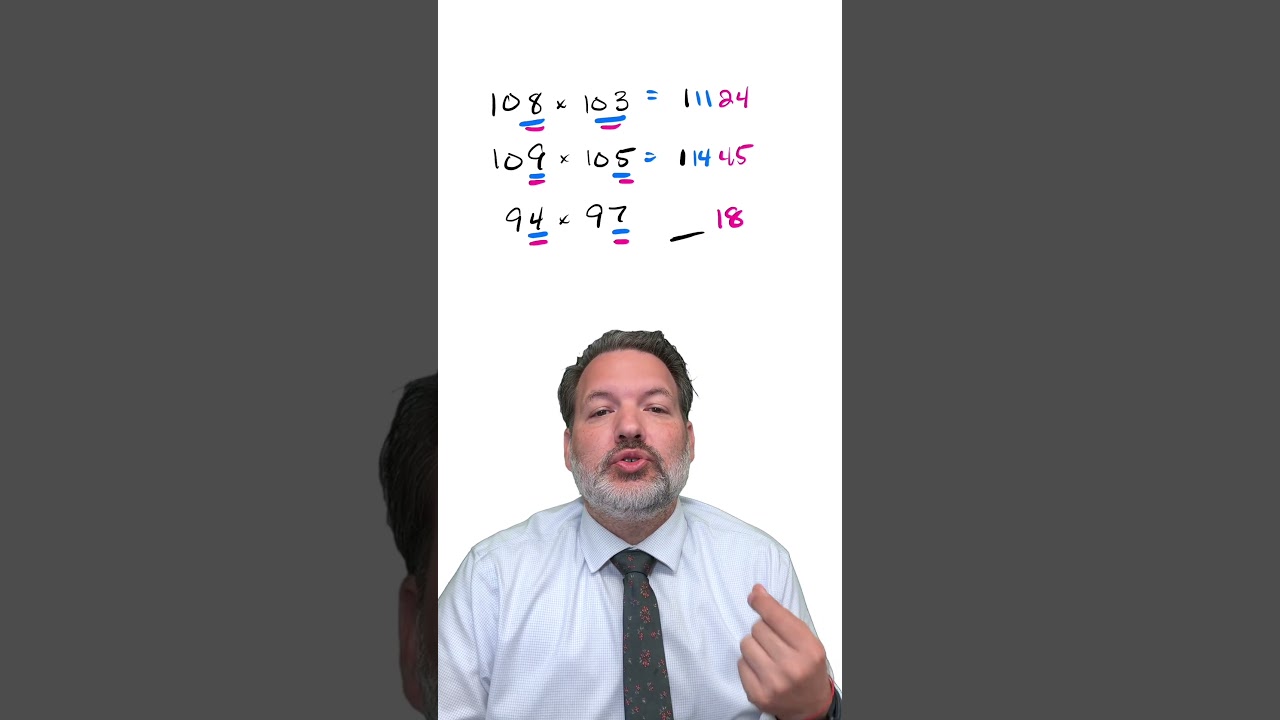
What's 108 × 103? It turns out you can answer that in your head in about two seconds, and the method works for any two numbers hovering near 100.
Start with 108 × 103. Add the "extras" past 100: 8 + 3 = 11. Multiply the extras: 8 × 3 = 24. Stick them together and you get 11,124 — which happens to be exactly 108 × 103. Try it with 109 × 105. Add the extras (9 + 5 = 14), multiply them (9 × 5 = 45), and you get 11,445.
This is one of those tricks that feels like a magic act the first time you see it, but it's actually a small window into how multiplication really behaves around a "nice" anchor number. The anchor here is 100, and once you see why 100 is doing the heavy lifting, the trick stops being a trick.
When you write 108 as (100 + 8) and 103 as (100 + 3), and you multiply them out the way you'd multiply binomials — partial products, or FOIL, or the box method, whichever your teacher called it — you get four pieces: 100 × 100, 100 × 3, 100 × 8, and 8 × 3. That's 10,000 + 300 + 800 + 24. Notice what happens next: the 24 has no friends in the ones or tens place, so it lands at the end of the answer untouched. The 300 and 800 combine into 1,100 hundreds, which together with the 10,000 makes 11,100. Drop the 24 on the end and you're at 11,124. The "add the extras, multiply the extras" rule is just the partial product layout collapsed into something you can do mentally.
What about numbers a little smaller than 100, like 94 × 97? Same idea, just from the other side. Now 94 is 6 below 100 and 97 is 3 below 100. Multiply the distances: 6 × 3 = 18. That's the last two digits. The first part is going to be a bit less than 10,000, because both numbers came in under 100. How much less? Add the distances (6 + 3 = 9) and subtract from 100 to get 91. Tack on the 18 and you have 9,118. Calculator agrees.
If you write 94 as (100 − 6) and 97 as (100 − 3), the same partial product structure explains it. You get 10,000 − 300 − 600 + 18. The two negative pieces total −900, knocking 10,000 down to 9,100, and the +18 from the two negatives multiplying nudges it up to 9,118. The signs flip, but the architecture is identical.
That's the part worth lingering on. The reason this works has nothing to do with 100 being special on its own. It's that 100 × 100 = 10,000 is a clean anchor, and the leftover pieces in (100 ± a)(100 ± b) are small enough to slot into the answer without crowding each other. It's the same math that runs underneath multiplying any two binomials, and it's the same math that will show up later when students start factoring quadratics. A good mental math trick is one that's easy to use and also points to something real underneath. This one earns it on both counts.
#mentalmath #multiplicationtrick #numbersense
Watch more Math Videos:
Math Minis: https://www.youtube.com/playlist?list=PLrc8spN1b3jkQynJ5heNvSs72gCPj_hwj
Math Minutes: https://www.youtube.com/playlist?list=PLrc8spN1b3jmVFYwHiuMzCYJ0y_yiwUge
Number Sense: https://www.youtube.com/playlist?list=PLrc8spN1b3jksKkY_oarNFEFAHjrIV97U
MATHCOUNTS: https://www.youtube.com/playlist?list=PLrc8spN1b3jlqDkZXtby9lnEaOBy7-ZY0
Follow Tim Ricchuiti:
TikTok: https://www.tiktok.com/@polymathematic
Mathstodon: https://mathstodon.xyz/@polymathematic
Instagram: https://www.instagram.com/polymathematicnet
Reddit: https://www.reddit.com/user/polymath-matic
Facebook: https://www.facebook.com/polymathematic