When the Next Number in a Sequence Isn't Math At All
Machine-readable: Markdown · JSON API · Site index
Описание видео
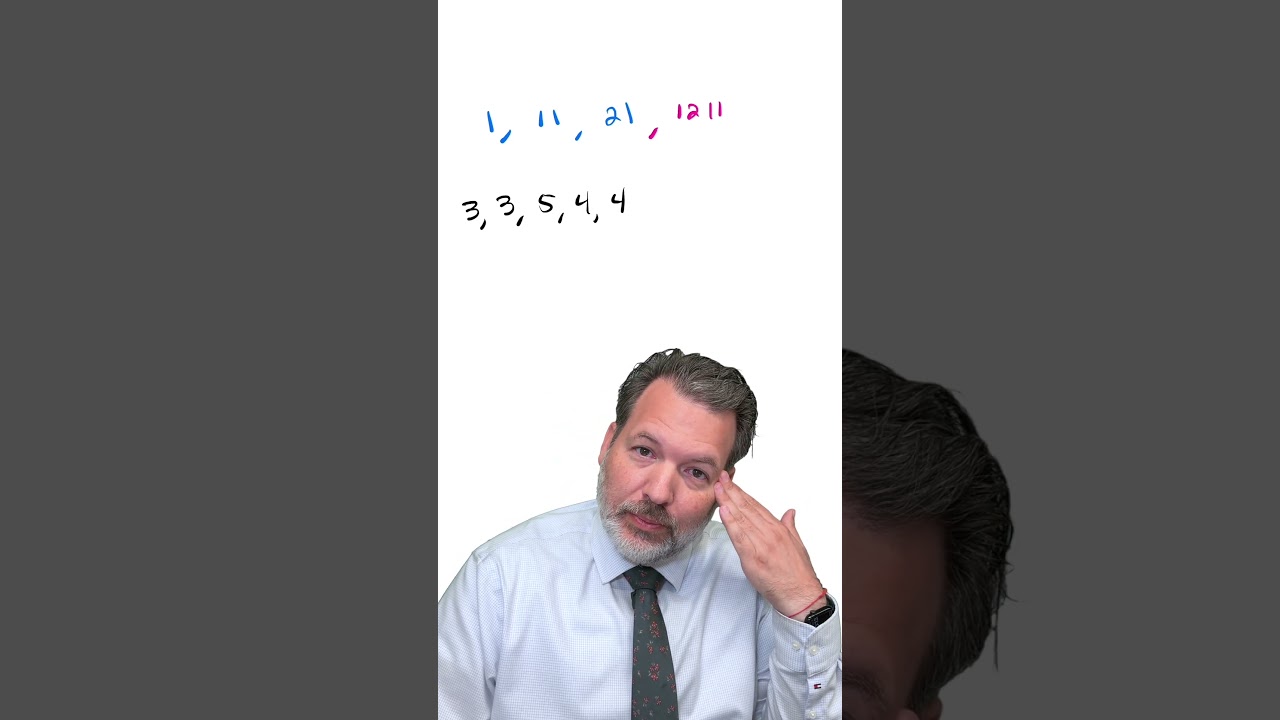
What comes next: 1, 11, 21, ___? The answer *could be* anything. The "obvious" answer is 31. But a much more enjoyable answer is 1211. And the reason isn't arithmetic.
Check out the channel! @polymathematic
Start with the obvious read. The sequence 1, 11, 21 looks like an arithmetic sequence: each term is 10 more than the last. So the next term should be 31. That's a perfectly valid pattern, and if all you're given is three numbers, "add 10 each time" is a defensible answer. Arithmetic sequences are one of the most basic patterns in math, and the rule "always go up by the same amount" is satisfying because it's predictable.
But there's a much more delightful pattern that fits these same three numbers, and once you see it, you can't unsee it. Don't keep reading unless you want me to spoil it for you!
Read the digits out loud. The sequence is generated by *describing* the previous term, not by performing any arithmetic on it.
- Start with 1.
- What's the previous term? "One 1". Write that answer as digits and you get 11.
- Then, what's the previous term? "Two 1's". Write that answer as digits and you get 21.
- And so on. What's the previous term? "One 2, one 1". Write that as 1, 2, 1, 1 and you get 1211.
Each term literally spells out what the term before it looks like. The "operation" isn't addition or multiplication. It's describing.
This is called the Look-and-Say sequence, and it was popularized by John Horton Conway, who studied its bizarrely deep mathematical properties. The next term after 1211 is 111221 (one 1, one 2, two 1's). The one after that is 312211 (three 1's, two 2's, one 1). Then 13112221, and so on. The terms grow roughly by a factor of about 1.303577 each time — a constant Conway proved is the unique positive real root of a particular degree-71 polynomial called Conway's constant.
This kind of sequence, sometimes called a non-operational sequence, points at a useful piece of mathematical sleight of hand. Most "what comes next" puzzles assume you're supposed to find the arithmetic rule. But sequences can be defined by *any* well-specified procedure, including procedures that have nothing to do with the numerical values themselves.
So if someone asks you for the next term in 1, 11, 21, the right answer depends on what kind of pattern they had in mind. If they wanted arithmetic, it's 31. If they wanted something stranger and richer, it's 1211. And if they were really mean, it's anything they want — because three numbers really *can* fit infinitely many rules.
#lookandsay #numbersequence #mathpatterns
Watch more Math Videos:
Math Minis: https://www.youtube.com/playlist?list=PLrc8spN1b3jkQynJ5heNvSs72gCPj_hwj
Math Minutes: https://www.youtube.com/playlist?list=PLrc8spN1b3jmVFYwHiuMzCYJ0y_yiwUge
Number Sense: https://www.youtube.com/playlist?list=PLrc8spN1b3jksKkY_oarNFEFAHjrIV97U
MATHCOUNTS: https://www.youtube.com/playlist?list=PLrc8spN1b3jlqDkZXtby9lnEaOBy7-ZY0
Follow Tim Ricchuiti:
TikTok: https://www.tiktok.com/@polymathematic
Mathstodon: https://mathstodon.xyz/@polymathematic
Instagram: https://www.instagram.com/polymathematicnet
Reddit: https://www.reddit.com/user/polymath-matic
Facebook: https://www.facebook.com/polymathematic