Why Dividend Growth Stocks Are Destroying Dividend Kings.
16:55

Why Dividend Growth Stocks Are Destroying Dividend Kings.

Dividend Data 26.04.2026 8 839 просмотров 431 лайков

Machine-readable: Markdown · JSON API · Site index

Поделиться Telegram VK Бот
Транскрипт Скачать .md
Анализ с AI
Описание видео
📥 Download Free Template: https://www.dividenddata.com/products/dividend-stock-watchlist-spreadsheet 🚀 Get Live Data in Your Spreadsheet (Free): https://www.dividenddata.com/sign-up-free 📥Download All Free Templates: https://www.dividenddata.com/templates ───────────────────────────────── 0:00 Why Dividend Growth is Beating Aristocrats & Kings 0:25 New Free Dividend Stock Watchlist 1:23 Intro 2:06 IBM stock 4:21 DELL stock 6:19 PG stock (Procter & Gamble) 7:28 COST stock (Costco) 10:52 CL stock (Colgate-Palmolive) 11:38 WM stock (Waste Management) 12:20 JNJ stock (Johnson & Johnson) 13:40 MU stock (Micron Technology) 14:49 FIX stock (Comfort Systems) 15:49 NDAQ stock (Nasdaq) ───────────────────────────────── (Google Sheets) Getting Started Video: https://youtu.be/ptYHf8bv8nY (Microsoft Excel) Getting Started Video: https://youtu.be/UWIhj-9FbMQ I built a free dividend portfolio tracker that pulls live data automatically — no copy-paste, no manual dividend entry, no workarounds. Track your projected annual dividend income, yield on cost, dividend growth rate, and monthly income projections — all updated automatically using the Dividend Data add-in (free tier available). Works in Google Sheets and Excel. 📥 Download the free Dividend Portfolio Tracker: https://www.dividenddata.com/products/dividend-portfolio-tracker-spreadsheet 📥 Download the free Dividend Stock Watchlist: https://www.dividenddata.com/products/dividend-stock-watchlist-spreadsheet ───────────────────────────────── My Links: 💻 Dividend Data: https://www.dividenddata.com/ Follow on X: https://x.com/dividend_data Listen on Spotify: https://open.spotify.com/show/4dBCd8IWgBYJgrbI2zROPR?si=084da0648e694103 Follow on Instagram: https://www.instagram.com/dividenddata/ ───────────────────────────────── Dividend Growth Investing creates cash flow without selling your position. Reinvested dividends compound powerfully over time — and tracking them properly is the first step toward financial freedom. Disclaimer: This is my opinion and not financial advice. #dividends #dividendinvesting #investing

Оглавление (13 сегментов)

Why Dividend Growth is Beating Aristocrats & Kings

All dividend stocks are not created equal. We just got a flood of new dividend declarations with increases ranging from 1% to 30%. And today I'm going to dive into some of these dividend stocks and explain why some companies are growing so fast and others are just slowly increasing. Why did a company like IBM only raise their dividend by 0. 6% while other tech companies like Dell raised their dividend by 20%? And before

New Free Dividend Stock Watchlist

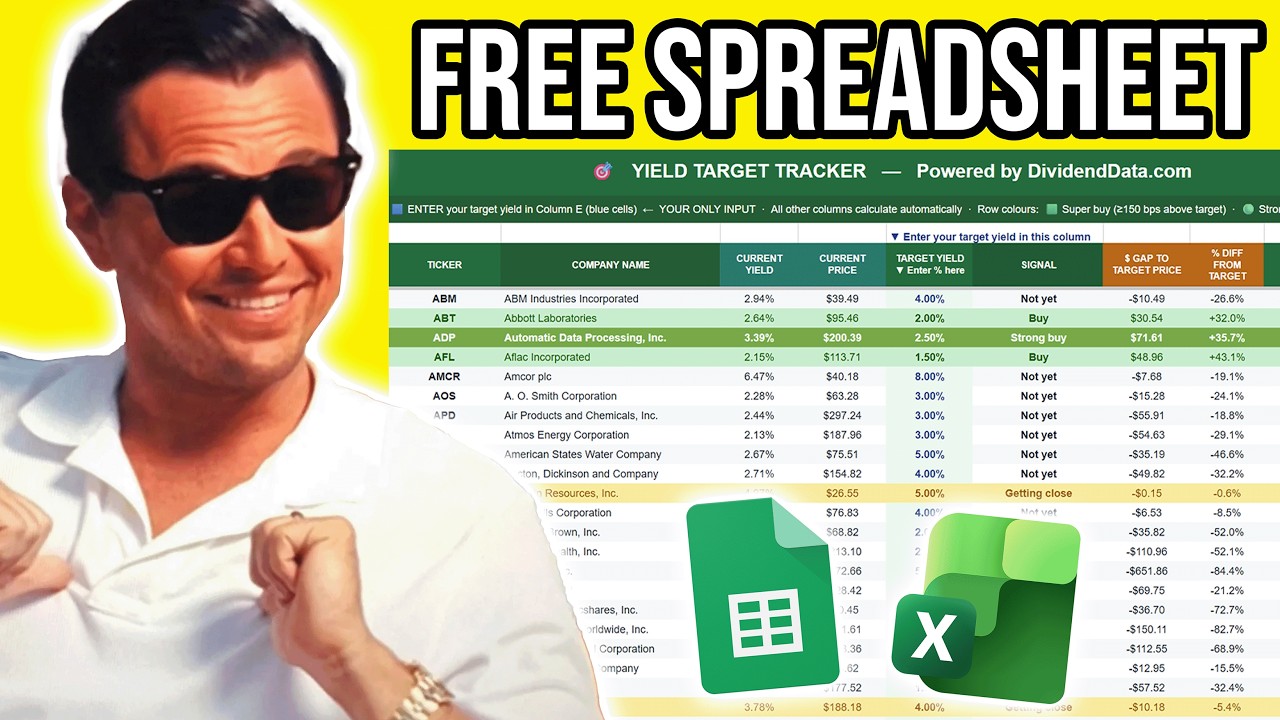
I dive into the video, I want to share that I just released the ultimate dividend stock watch list. It's available for Google Sheets and Microsoft Excel. All you have to do is enter your tickers and it auto fills with all of the related dividend data so that you can keep up with all of your different stocks you're tracking. It's powered by our dividend data add-in and you can download the template for free and start using the tool for free. The link is in the description and pinned comment of the video. There's a bunch of other great features in it like our yield target tracker where it tells you if something's a buy, a strong buy, or getting close to your target yield. Also, a yield history analyzer where you can plug in any ticker and it auto fills with the data and lets you know over the past 5 years the range of the dividend yield. And this is really good if you're trying to optimize your buying point and buy towards the high end of the dividend yield historically. Plus, on the watch list there is a calendar that shows the upcoming execution dates and dividend dates for all the declared dividends. This is the latest declared dividend for each company on the list. So, with that said, let's get into the video.

Intro

— The following reflects the opinions of a man who spends far too much time thinking about stocks. Please do your own research before making any investment decisions. Nothing in this video is personal financial advice. Continue at your own risk. On our dividend data research

IBM stock

terminal, we have a dividend newsfeed that shows all of the latest dividend increases and you can even have that filtered by stocks in your portfolio and on your watch list. And we have been getting a flurry of increases in recent weeks. So, today I'm going to filter through some of the best and most notable dividend raises and I'll be providing examples of companies that had a strong dividend raise and low dividend raise. And dive into some of the unique reasons about why this happens and what it means for the stock, possible stock price appreciation in the future, and future dividend raises. And to start, we're going to dive into IBM. They just had a 0. 6% dividend raise. And as we dive into IBM, this stock was not doing well for many years. Really from 2010 through 2023, the stock was going nowhere and had net negative total return. However, during that time they did have large dividend raises, but in the past 2 years IBM stock price performance has done much better and they're starting to see a trend towards earnings growth again. However, now that the price has gone up, the dividend yield is also lower at 2. 91%. But this growth is not showing up yet in the dividend for IBM. This is a company which historically was a high dividend growth stock, but really since 2018 that growth has plateaued and since 2021 it has been extremely slow averaging 0. 6%. The 3-year dividend CAGR is 0. 6% and despite the recent stock price improvement at IBM, management has not changed their outlook in terms of dividend growth. Now, this could just be conservative, but it might also say something about how they think about the business in coming years. Now, this dividend is sustainable with a free cash flow payout ratio of 54% and a 59% earnings per share payout ratio. But IBM, it's pretty interesting. They're starting to see a trend towards improved growth, but if we look at the annual free cash flow, the company's free cash flow per share has not changed at all since 2009. It's actually gone down in that time. So, for a while IBM was looking super cheap. That's why even back in the day Warren Buffett bought the stock, but it ended up being a mistake and he sold it. So, financially IBM looked super cheap for a while, but as of right now the actual earnings and free cash flow and dividend growth are not really lining up with the massive stock price appreciation over the past couple years. This is in contrast to

DELL stock

Dell, a company that just raised their dividend 20%. That's ticker symbol D E L L. And for a while Dell was off my radar completely because I just viewed them as the boring PC company and that is not really a growth business at all. But Dell actually has a very strong foothold in the server industry in data centers and that's becoming a big growth business for them. As you can see, they just had a recent high in earnings per share and analysts are projecting 27% annual EPS growth next year followed by 15%, 24% and the stock price is starting to move up as well, but overall it still trades at a relatively attractive valuation. The dividend yield is low at 1. 17%, but this is a 20% payout ratio stock. And the 3-year CAGR for Dell is now 24% on their dividend. And since 2022 Dell has been increasing their payout every single year. That was 20%, 18%, 20% and it's a very sustainable payout ratio. And Dell is about to see some massive growth. You're already seeing their highest quarterly revenue per share, but I'm going to head over into Excel and load in their KPIs using our dividend data add-in. And the reason why I'm loading this in is so that you can see the part of their business that's really growing right now. And that is server and networking revenue. You can see in the past year this revenue has grown from $6 billion to $14. 8 billion. That's their quarterly revenue. It has grown more than 100% year over year. And right now with the big data center build-out relating to AI, that only seems like it's going to continue. And the server side of the business has now become their largest business segment. It's bigger than the entirety of their PC business as both in commercial and consumer. And it's about 75% of their infrastructure side of their business. So, this is something I always like to see where the largest part of a company's business is their fastest growing part of their business. And that's why a company like Dell just raised their dividend 20% and likely will continue raising it in the future at a high rate. Another dividend raise

PG stock (Procter & Gamble)

we had recently was from a dividend aristocrat and dividend king Procter & Gamble, ticker symbol PG. They raised their dividend 3%, which is on the lower end. This company has a 2. 94% dividend yield. It's an extremely dominant, reliable company in consumer products. And this is a juggernaut that has been in a dominant position for a long time and they've been a reliable dividend raiser every single year. The 10-year compound annual growth rate of the dividend is just under 5%, but this latest 3% raise is a slow down from their historical rate. If we look at their payout ratio, it is still sustainable, 70% free cash flow payout ratio, 61% based on net income. Dividend yield is just under 3% and this is still a great, high-quality company, especially if you already own a ton and you're just earning the dividends, reinvesting the dividends. The dividend payment's not going anywhere, but you likely won't see high total return out of the stock, at least not at this price. At the current phase of Procter & Gamble, they're not a high-growth company and they've already been doing a lot of price increases in recent years to keep up with inflation. So, I'm not worried about Procter & Gamble, but I don't see high dividend raises in their future. By comparison, we just had

COST stock (Costco)

Costco, which raised their dividend 13. 1% and the reason why I'm relating these two companies is cuz they show a little bit of the dynamic between the consumer packaged goods that are sold in stores and the actual retailers themselves. And Costco is pretty much the best retailer in existence and they are constantly trading at a premium valuation, but it's backed up by earnings per share growth. Dominant market position, high earnings per share growth 10% plus a year, to low dividend yield, but this is their base quarterly dividend and they increase that every single year around 10 to 13%. Most recent was 13, the one before that was 12, 13, but they also do these large special dividend payments every few years. So, that probably puts the blended average of the yield closer in the 1. 5% range. But the growth at Costco is off the charts compared to Procter & Gamble. Revenue per share growing at a 5-year CAGR of 10%, free cash flow per share is growing at 10-year CAGR of 15. 15% and they've got $18. 2 billion of cash and short-term investments, so they could have another special dividend coming up. As you can see, the last time they were this high, that's when they paid their special dividend. And the balance sheet of Costco is way better. They've negative $10 billion of net debt, so way more cash than debt. And in general, the highest quality retailers, they are in a very strong position compared to the consumer packaged goods companies, especially for a lot of things that are in the more commodity category. Now, CPG companies like Procter & Gamble, they try to develop very high-quality brands that kind of shield them and have consumer preference, allowing them to charge higher prices, but private label products are becoming very popular at retailers. It's a trend across the whole industry, has been for decades. Costco's Kirkland products, Kirkland Signature, one of the best examples of that. And this gives Costco and other retailers a lot of negotiating leverage against CPG companies. But people always wonder why a retailer like Costco trades at such a high valuation and the reason has very little to do with the retail side of the business. That's the foot in the door. Costco is a membership business. In order to shop at Costco, you need a membership and they continue to open more and more stores growing that membership side of the business and this is pure profit. So, while the retail side is very high revenue numbers, but it's really low margin, they constantly are growing this membership side, which is a high margin subscription business. And if we look at the annual KPIs for Costco, you can see with the membership revenue. From 2012 to 2025, they've grown that from $2 billion a year to $5. 3 billion a year. And people are realizing a decade from now, this is probably going to be a $10 billion a year. And that membership is severely underpriced as well. It's cheap. So, theoretically, they could raise the price on that membership, and that is pure profit. They could do that at any time. Even a $10 raise would be massive profit to Costco's bottom line. And this high-margin subscription revenue that deserves to trade at a higher multiple. And if we look at the free cash flow a company like Costco generates, it's $7. 8 billion of free cash flow. So, a sizable chunk of that is coming from that membership side of business. So, people put a high multiple on the valuation of that side of the business. And that's why Costco is going to keep compounding. It's going to keep seeing high dividend increases. And the total return is probably still going to be pretty good, even though it's expensive right now. Another example of

CL stock (Colgate-Palmolive)

slow dividend growth is Colgate-Palmolive, ticker symbol CL. They raised their dividend 1. 9%. Current dividend yield is 2. 5%. And this is another CPG company that has seen plateaued growth. And despite a very strong history of dividend raises and consistent annual increases, the raises are slow. The two prior raises were around 4%, which were on the high end for them. But this latest 1. 92%, that's a downward trend. And the five-year CAGR of the Colgate-Palmolive dividend is 3. 3%. This is a sustainable payout though with a 50% free cash flow payout ratio and 85% earnings per share payout ratio. But if you're investing in CL stock, you shouldn't expect high dividend growth moving forward. But this is not true of

WM stock (Waste Management)

all dividend aristocrats and dividend kings. As an example, we have Waste Management, ticker symbol WM. They just raised their dividend by 14. 5%. Current dividend yield 1. 65%. And this is a consistent compounder with higher earnings per share growth. Dominant market position, arguably much more than those CPG companies. And they've been raising their quarterly dividend every single year. Five-year CAGR of 10. 45%. Again, they just had a 14 and 1/2% increase. And their free cash flow payout ratio is 47%, very sustainable, 49% based on earnings per share. So, there definitely are some dividend aristocrat stocks that are growing their dividend fast and having pretty solid total return as well. But there is a trend among a lot of these companies

JNJ stock (Johnson & Johnson)

that the growth is not that high. You have a company like Johnson & Johnson. They raised their dividend by 3. 1%. And I actually haven't looked at this stock in a while. They just had a stock price boom over the past couple years. So, their dividend yield is now down to 2. 36%. But this is not really showing up so far in their earnings per share. It's not showing up yet in their dividend growth. They actually were much more conservative with their latest dividend raise, 3%. That's down from 4. 84% and 4. 2% before that. It is very sustainable though. Free cash flow payout ratio of 62%, earnings per share payout ratio 46%. I don't know why the stock price has gone up so much. I know there were some lawsuits related to Johnson & Johnson. I don't know if that had a positive result for them. I also know that they spun out their consumer packaged goods part of the business. So, it's much more focused on healthcare and pharmaceuticals. And analysts are expecting pretty good earnings per share growth in the coming years for Johnson & Johnson. But I wouldn't really say this is showing up in the results so far, and the dividend raise was definitely conservative. These are the side of dividend stocks though that are the Mr. Reliables. They are going to pay pretty much no matter what. They're going to raise their dividend payment every single year. They're not going to cut it for the most part. Pretty safe dividend payments. And if you're looking for consistency and you value the reliability of your income, this is probably a good position to be in. But on the complete opposite side of

MU stock (Micron Technology)

reliability, you have some high-growth, more cyclical names, things like Micron Technology, ticker symbol MU. They just raised their dividend by 30%. And if you notice here, if we look at the stock price, it has exploded up 522% over the past year. That's because they make memory. There's a memory shortage related to the data center buildout with AI right now. So, we are right now at the peak bull market side of the commodity boom. This is a very cyclical business. You can see from their historical earnings, it's up, it's down, it's up, it's down. Right now, we're at up, and we're at a peaking up that's probably going to keep doing well for the next few quarters. But in terms of the dividend, this is not really a dividend stock you want to be focusing on for the part of the dividend. Yield is now like nothing, 0. 12%. Extremely sustainable though. But this is a company that has basically cut their dividend because it's hard in a cyclical business like this to have a balance sheet where you can supply and continue paying the dividend in the downswings. But right now, they're raking in so much cash that they are feeling more confident and raising the dividend.

FIX stock (Comfort Systems)

dividend. And as I wrap up this video, there are some more high-quality companies that are raising at a higher rate that are also benefiting from some big growth trends right now, like the AI data center buildout, which is really powering a lot of the stock market at the moment. As an example, we have Comfort Systems USA. They raised their dividend by another 14. 3%. This is an HVAC company. And this stock has been growing insane. I started covering this last year. And since then, it's gone up 333% in stock price. Earnings per share continue to hit new highs quarter after quarter. Analysts are projecting 50% earnings per share growth this year and 23% in the years following. And they have been raising their dividend every single quarter. The three-year CAGR for this dividend is 65%. Over the past year, 78% it's gone up. Now, it's very low yield, 0. 19%. 6% free cash flow payout ratio, super sustainable. So, their earnings and free cash flow are much higher than this dividend represents. Another big raise

NDAQ stock (Nasdaq)

we had this week was actually from Nasdaq, ticker symbol NDAQ. They raised their dividend by 15%. This one's a higher yield, 1. 38%. Consistent payer, their earnings per share are growing at a high rate, recently hitting all-time highs. The five-year compound annual growth rate of this dividend is 11. 5%. And this recent 14. 8% raise is actually higher than both of their prior payments. So, we're seeing an acceleration in dividend growth. I would say that signals management confidence in how their business is performing. It's a very sustainable, 30% free cash flow payout ratio, 33% EPS payout ratio. And of course, there's a lot more dividend raises I could cover. But for the purposes of this video, I tried to give you a good analysis of some slower growing ones and some high-growth ones and the reason why that's happening at each company. And if you want to use that free dividend stock watch list that I showed earlier in the video, you can download with the link in the description and pinned comment of the video. I recently made a full video breaking down all of the different features of it, how it works. I'll link that at the end screen of this video. And if you enjoyed, make sure you leave a like, comment, and subscribe to the channel. And with that said, thanks for watching. I'll see you in the next one.

Другие видео автора — Dividend Data

Ctrl+V

Экстракт Знаний в Telegram

Экстракты и дистилляты из лучших YouTube-каналов — сразу после публикации.

Подписаться

Дайджест Экстрактов

Лучшие методички за неделю — каждый понедельник