Grab your free seat to the 2-Day AI Mastermind:
https://links.outskill.com/ACTIONLABSJUN1
🔐 100% Discount for the first 1000 people
💥 Dive deep into AI and Learn Automations, Build AI Agents, Make videos & images – all for free!
🎁 Bonuses worth $5,100+ if you join and attend
Оглавление (2 сегментов)
Segment 1 (00:00 - 05:00)
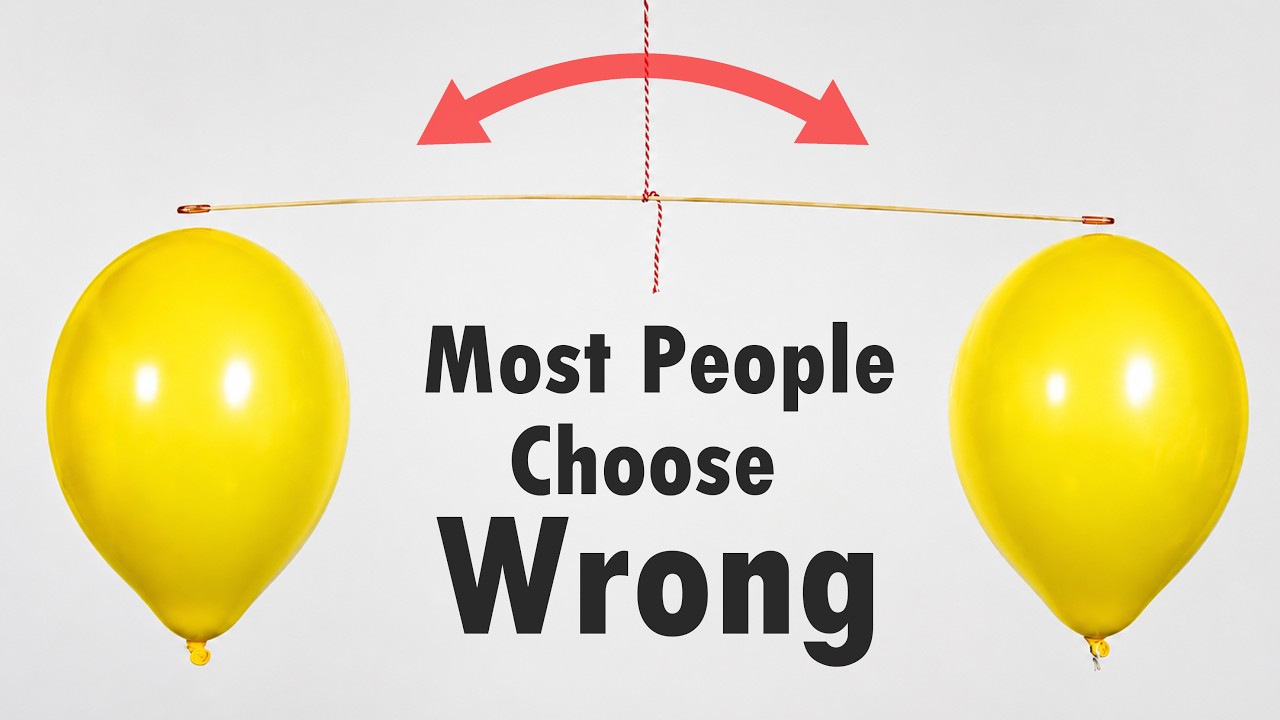
Okay, I have two balloons that are the exact same weight hanging by a thread on both ends of this rod here. So, the question is, what happens when I let out the air in one of the balloons? Will it stay balanced, tilt to the right, or tilt to the left? And now, if you think you can answer that, what if instead of air, the balloons are filled with water and the whole setup is in water as well? The balloons still fall like in air when you drop them. So, what happens when I let the water out of one of the balloons? The answer may surprise you. In this video, I'm going to show you an experiment that seems to break intuition, but ends up revealing one of the biggest differences between liquids and gases. But before we continue, I want to thank the sponsor for this video, outskill. Have you noticed how claude is suddenly everywhere right now? And naturally, everyone online keeps saying you need to learn AI, but almost nobody actually teaches you how to use these tools in a practical way. That's why Outskill is hosting what they call the world's first Claudeathon happening live this weekend from 10:00 a. m. to 700 p. m. Eastern time. It's a two-day deep dive into Claude and more than 10 other AI tools. And right now, they're giving away a,000 free seats for a limited time. More than 10 million people worldwide have already attended their trainings, and they're rated 4. 9 out of five on Trustpilot. During the workshop, you'll learn how to do deep research with Claude, build your own dashboards and artifacts, create presentations with AI, connect tools together to automate workflows, and build custom GPTs and agents, and even generate videos and visuals with AI. They even show you things like setting up Claude connectors to automate tasks like job searches and other repetitive work. And if you sign up now, you'll also get bonuses like 50 secret Claude codes to make Claude way more powerful. And you'll also get an AI prompt library and a personalized AI toolkit builder completely free. The training is also mentored by leaders from companies like Microsoft, Google, Amazon, and Nvidia. So, if you want to check it out, use the link in the description or scan the QR code on screen and join the WhatsApp community before the free seats run out. And thanks again to Outskll for sponsoring this video. Now, let's get back to our experiment. So, let's start off with the first experiment. I have two balloons here that I filled up with compressed air to the same size. Then I attach them to the stick here. You can see that it's pretty well balanced, not tilting one way or the other. I have a clip on the end that I'm going to remove to let the air out and then put the clip back on the balloon. So, the question is, what happens when I let the air out of this balloon? What will happen? Okay, here we go. We're going to let the air out. And you can see that now the balloon that still has air in it is heavier than the one without air in it. Before we talk about why this happened, let's go to the next case. Now, now I'm going to do my best to do this exact same setup, except that instead of air, we're going to use water. And the whole thing is done underwater. So, first I'm going to fill up this big chamber with water. Now, I need to fill up the balloons with water while they're under the water. Okay, there we go. Now, the rubber balloons naturally float in water, but I need to make this comparable to the air version. So, I need them to sink instead of float. So, they'll naturally fall downward. So, I'm going to put a little weight inside of them. Now, the balloons naturally want to fall down in the water. So, I'll hook them to the rod so they're balanced on either side. So, now let's see what happens when I let the water out of one of the balloons. Okay, let's take off the clip. Okay, after I let it settle, you can see that it doesn't tip either way. It stays exactly balanced, just like it was before I let the water out. So, why did this happen? How come in air, the balloons become way off balance when I let the air out of one side, but in water, they stay balanced? Well, air has mass, which means it also has a weight. But because we're surrounded by air, that means we don't feel its weight. You can see this a little more clearly with water. For example, I have around 170 gram of water in this ball here. When I put it on a scale, you can see I have around 178 g, which is the weight of the container plus the water. But now, if I surround the scale with water instead of air, then we get something completely different. You can see I get only around 8 g. The weight of the water has just kind of gone away and I'm left with just the weight of the container. So, you can't weigh water in water. And you also can't weigh air in air. So, now with our balloons in water, it's clear why when we let the water out of the balloon or in the balloon, it didn't tip the rod to either side because the water doesn't weigh anything when it's surrounded by water. So, it doesn't matter whether that weightless water is in the balloon or out of the balloon. It won't tip the scale either way. But why isn't that the case with air? Well, air, like all gases, is compressible. That means you can easily squish it. So, if I take this syringe, it's pretty easy to change the
Segment 2 (05:00 - 06:00)
volume of the air inside by adjusting the pressure on the syringe. But with water, that isn't the case. No matter how hard I push on the water in the syringe, I can't really change the volume. So, let's ignore the weight of the actual balloon and just deal with the weight of the water or air in the balloon. So, that means with a balloon of water, the water inside is the same density as the water outside, which means the buoyant force exactly cancels the weight of the water. So when you let the water out, nothing changes to the overall force on both sides. But for the balloon with air, the air inside is squished and more dense than the air outside the balloon. So the buoyant force of the air around it doesn't cancel out the weight of the air. So when you let the air out of one of the balloons, it tips. This experiment clearly shows the difference between liquids and gases. This means that a basketball that's fully inflated weighs more than a flat basketball or a carbonated soda weighs slightly more than a flat soda of the same volume. This whole difference comes from the fact that gases are squishy. So why is it so easy to compress a gas but so difficult to compress a liquid? Well, remember that a gas is already mostly empty space. When you make the volume smaller, you're mainly just pushing the molecules closer together. So the molecules collide with the walls more often and the pressure rises. But with a liquid, the molecules are already packed tightly together with almost no empty space left. So compressing a liquid means trying to force the molecules themselves closer together against extremely strong atomic forces, which is much harder to do. And thanks for watching another episode of the Action Lab. I hope you learned something. If you haven't subscribed to my channel yet, remember to hit the subscribe button and we'll see you next time.