The iGarden M1 is a next-generation pool robot featuring a 3-year warranty, an AI-powered 20-minute quick clean mode, and up to 16 hours of runtime on a single charge
Amazon:
https://geni.us/7h53Zo
code: IGDTAL05 (5% off)
Official Website:
link:https://igarden.short.gy/1PMmkC
code:ActionM5 (5% off)
#iGarden #iGardenM1 #RoboticPoolCleaner #pool #poolcleaning #PoolCare #PoolMaintenance #bestendurance #poolvacuum #summer
Оглавление (2 сегментов)
Segment 1 (00:00 - 05:00)
If you move at a constant velocity, the laws of physics behave exactly the same. But rotate at a constant rate and suddenly the ball curves sideways as if physics itself changed. Constant velocity and constant rotation are both forms of motion that continue naturally because of inertia. So why can one of them be felt while the other can't? This one strange fact sent physicists down a rabbit hole that eventually led to Einstein's theory of general relativity. In this video, I'm going to talk about the mystery of inertia and why space-time may be far more than just an empty background where physics happens, but something that helps define motion itself. Ever since Galileo, physicists had understood that motion at constant velocity is relative. This means that if two people move past each other through space at a constant velocity, each can assume that they're stationary while the other person is moving. Every experiment they could perform will give exactly the same results. But something different happens when one of them accelerates. Even though each person can claim that the other one is accelerating, they both immediately know who actually accelerated because the laws of physics suddenly behave differently for that person. They throw a ball upward and instead of falling back into their hand, it now falls behind them. That's why when we spun our ball car, the ball landed off to the right because rotating objects are under constant acceleration. Isaac Newton found this peculiar. Why should velocity be relative while acceleration isn't? The only way this can make sense was if there existed some deeper background reference defining what counted as natural motion. So Newton imagined that space itself possessed a kind of invisible structure where objects naturally move along straight paths at constant velocity. — As long as an object continued along one of these straight paths, physics behaved exactly the same no matter which constant velocity path it was on. But the moment the path curved or changed, physics suddenly behaved differently. So, in order to prove the need for a background reference point, Isaac Newton came up with a famous experiment that he believed stood as solid proof for the existence of fixed space. He called it the bucket experiment. But, before we continue, I want to thank the sponsor for this video, iGarden. This is the new iGarden robotic pool cleaner M1 AI series. I love that it looks like a cool electric car. So, I tested out how it performed cleaning a pool that had been sitting all winter. The coolest thing about this next-generation pool robot is that it doesn't just randomly bounce around the pool like a lot of older pool robots. It actually uses bionic AI dual camera vision and intelligent path planning to map out organized cleaning paths across the bottom of the pool. So, it cleans way more efficiently and can handle a quick clean in as little as 20 minutes. It's a good example of where robotic pool cleaners are headed in the future. It can climb walls, clean along the waterline, and even detect concentrated debris, so it focuses extra attention where the pool is dirtiest. The suction is strong enough to pull in leaves, dirt, and even small stones while still maintaining traction for climbing vertical pool walls. And since it's cordless, you can just drop it into the pool and let it do its thing without dealing with cables getting tangled everywhere. — It collects the large debris in the filter, which is super simple to take out and empty. It has an app that connects to it, or you can just select the cleaning mode right on the robot and place it in the water and let it do its thing. And because it gets up to 16 hours of run time plus smart scheduling through the app, you can basically keep your pool clean and maintained for up to 30 days without really having to think about it. But, what I thought was interesting is that after looking into the company more, this actually isn't just some random rebranded robot company. iGarden is backed by Fairland Group, and they've been building pool technology for years. Not just robotic cleaners, but also heating system, pumps, sanitation systems, and smart pool controls. So, if you want to check it out, I'll put a link in the description. It also comes with a 3-year warranty. And thanks to iGarden for sponsoring this video. Now, let's get back to our experiment. So, imagine taking a bucket of water. You know that if you spin this bucket, at first the bucket walls will slide past the water. But after a while, the water starts spinning as well. Then the water gets thrown outward as it matches the speed of the bucket. Then if you suddenly stop the bucket, the water will keep moving even though the bucket walls have stopped. Then eventually the water will stop again and match the bucket walls. So, let's look at this from the point of view of the water right when the bucket starts moving and stops moving. I also added some floating particles in the water so you can tell when the water is actually moving. So, right when the bucket starts, you can see the bucket walls spin around the water and the water is flat. But now let's look at the point of view when the water's spinning. In order to see the point of view of the rotating water, I have to spin the camera at exactly the same rotation rate as the water. So, when we match the reference point of the water, we can see that the water and bucket are still. But now we suddenly stop the bucket. So, from the
Segment 2 (05:00 - 09:00)
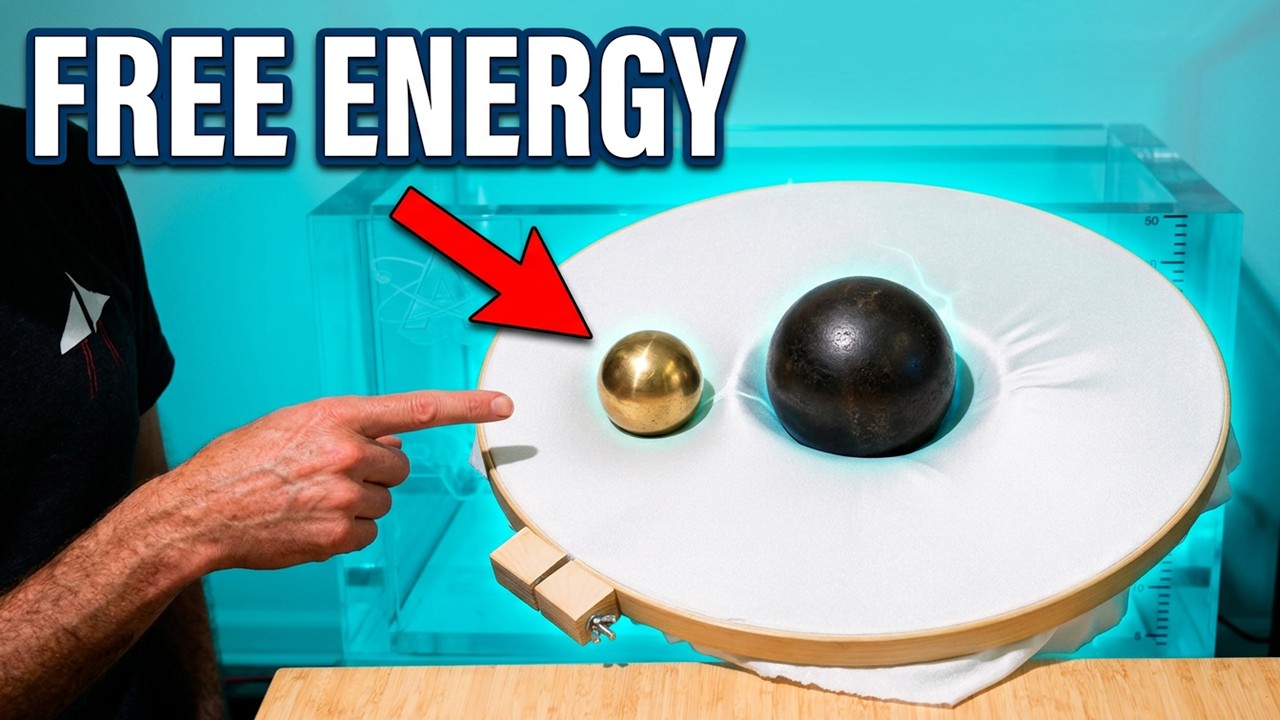
point of view of the water, the bucket suddenly starts rotating. Now, this is where it gets interesting. Notice that I now have two situations with a rotating bucket wall and still water. Yet the physics in these two systems are completely different. In the one on the left, the water is stuck to the sides, while on the one on the right, the water is flat. Now, Isaac Newton said the only way to reconcile this was to say that there must be some outside reference point that tells us when the water itself is actually spinning. You can't use the reference point of the bucket walls because we can clearly see that the bucket walls are moving at the same rate, but the water inside is acting different. If there were no outside reference point, then these two systems should behave exactly the same. So, he viewed this experiment as proof that there's a fixed space everywhere in the universe. This idea stood for nearly 200 years until the Austrian physicist and philosopher Ernst Mach challenged Newton's logic in the late 1800s. Mach argued that Newton's conclusion from the bucket experiment wasn't necessarily correct. Instead of proving the existence of absolute space, Mach proposed that the reason we can tell the bucket is rotating is because the universe is filled with stars, planets, and galaxies that provide a reference for rotation. In Mach's view, this non-inertial motion like acceleration and rotation is defined relative to all the matter in the universe, not relative to this mystical space itself. Mach argued that if the distant stars and galaxies rotated around a stationary bucket, then the bucket's water should still climb the walls because rotation only has meaning relative to the rest of the matter in the universe. Now, one of Mach's biggest fans was Albert Einstein. Einstein became fascinated by Mach's idea that all the matter in the universe might somehow influence inertia and motion everywhere else. Up to this point though, Mach had never provided an actual physical mechanism for how this interaction would work. His idea was more philosophical than mathematical. But as Einstein tried to prove Mach right and dove deeper into the mathematics, he discovered that space and time are not rigid passive backgrounds at all. Instead, space-time itself is dynamic and influenced by matter and energy. Massive objects literally distort the geometry of space-time. So, this completely rejected Newton's picture of space as a fixed invisible stage sitting behind reality. But Newton was still right in an important way. The only difference is that this background that we call space-time is bendable and changing. But it still acts as a reference point that tells the universe who's actually accelerating or rotating. So, in setting out to prove Mach right, Albert Einstein actually proved him wrong, mostly. One saving grace for Mach is that other objects in the universe really do influence the inertial behavior of other objects. This effect is called frame-dragging. In general relativity, a rotating mass doesn't simply sit inside space-time. It actually drags space-time around with it slightly. This means one rotating object can slightly influence the rotational motion and inertial reference frames around another object purely through the geometry of space-time itself. But, this effect is tiny, nowhere near what Mach expected. So, after centuries of debate, the answer turned out to be both simpler and stranger than anyone expected. We all exist inside this dynamic space-time web that defines inertial motion and acts as a kind of reference structure for acceleration and rotation. But, unlike Newton's rigid absolute space, this space-time isn't fixed or unchanging. It can bend, stretch, curve, and even be dragged around by matter itself. Different observers may not even agree on measurements of space and time, yet the geometry of space-time still determines what counts as natural motion and what counts as acceleration. So, the next time someone asks why water climbs the sides of a spinning bucket, you can simply tell them it's because of the geometry of space-time itself. And thanks for watching another episode of The Action Lab, and we'll see you next time.