This is called a gravity assist. It's a maneuver you can do in space that seems to break the laws of physics. You can gain energy equivalent to tens of tons of rocket fuel without firing your engines. And I'm not just talking about falling toward a planet and speeding up. I mean that if you add up both the potential and kinetic energy of the spacecraft before it passes the planet and compare it to after, it actually ends up with more total energy than it started with. This is the same method that Voyager 1 and 2 used to gain enough energy to leave our solar system. But where did this extra energy come from? Well, in this video, I'm going to show you how a gravity assist works and why it's the closest thing we get to free energy. Gravity isn't a source of energy. Using gravity to do any work or get anything moving is always paid for in advance. When we use water in a dam to make electricity, the sun lifted that water up through evaporation so it could later fall back down. The energy from a moving pendulum doesn't come from gravity. It comes from the initial push against gravity, lifting it up. So, you can't use a force like gravity to make energy. That's why as you drop something from very high in space and slingshot it around a planet at a given distance from that planet, you can't ever get it to a higher velocity than it started with. Let me show you what I mean. I have here a model that can represent gravity. This is just some spandex stretched over a large ring. If I put a large and a small mass on here, we can correctly simulate how these two masses would move in space due to the attraction of gravity. I can even show orbits. But since our fabric has some friction, the orbits don't last as long as they would in space. So, let's see what happens when we have a planet just sitting there in space and fly by it. My smaller mass is rolling down an incline at a set velocity. And as I fly by it, let's look at what happens to the velocity. Now, it's hard to see what happens here. So, I'm going to analyze its velocity. And we can see that the ball's velocity increases as it falls in, but then it actually decreases to be slower than it was when it started. It decreased a little bit because our fabric has friction, but in space, we would end up with the same velocity before and after. So, this doesn't look like gravity is going to help us increase our kinetic energy. We just fall in and then climb out of the gravity well. And this makes sense because like a rolling ball down a hill, as the ball rolls down, it gains speed. But to get back out, it has to climb back up that hill. So the gravity from the hill doesn't give it more energy or velocity. But if this is true, how did Voyager 2 end up gaining velocity as it flew by Jupiter, Saturn, and Uranus? If anything, it should be slowing down as it climbs out of the gravity well of the sun. Well, the missing piece from all these gravity assists is that in our model where we saw no speed increase, our planet was standing still. But remember, the planets are not just sitting there in space. They're orbiting around the sun at enormous speeds. So, let's try this experiment again, but this time our mass is moving through space as we pass it. But before we continue, I want to tell you about our sponsor, Freeash. Freecash is a platform where companies pay you to try their games or apps. Now, that sounds odd, but the reason they do that is because these game companies are already spending money on ads to get players. So, instead of just showing you an ad, they'll actually pay you a small amount to download the game and reach certain milestones. So, this isn't passive income or anything. You're actually doing small tasks in order to earn money on the app. But, if you're already going to be killing time playing a game anyways, you might as well be earning money doing it. So, I tried it out with Palman Survival here. Now, one thing you have to make sure of is that you enable app tracking, otherwise it won't register what you're doing. And the part that matters most is I tested withdrawing the money as well, and it did actually go through. The first cash out starts at $25, which is a lot lower than other similar apps. You can cash out on things like PayPal, Venmo, Google Play, Amazon, Apple, and many others. Now, I've seen some offers take longer than others, and not everything pays the same. So, it's one of those things where you kind of have to pick what's worth your time. If you want to try it, there's a link and QR code you can use, and they give you a $10 bonus when you start your first offer. So, if you want to check out free cash by clicking the link in the description. Now, let's get back to our experiment. So, now let's shoot our smaller mass by a planet that's moving and see what happens. So, if we look at the velocity now, it's very different. We actually increased in speed from 1. 1 m/s to 1. 6 m/s. That's a 45% increase in velocity. Looking at both of these together, you can see that with the moving and non-moving larger mass, the small ball starts out at similar velocities. As they approach the large mass, they both speed up near it. But in the case of the non-moving mass, the smaller ball then climbs back out of the gravity well and slows down, eventually returning to the same speed it started with, or even a little bit slower due to friction. But the moving mass case actually leaves with higher velocity than it started with. But how didn't it also have to climb out of that
Segment 2 (05:00 - 08:00)
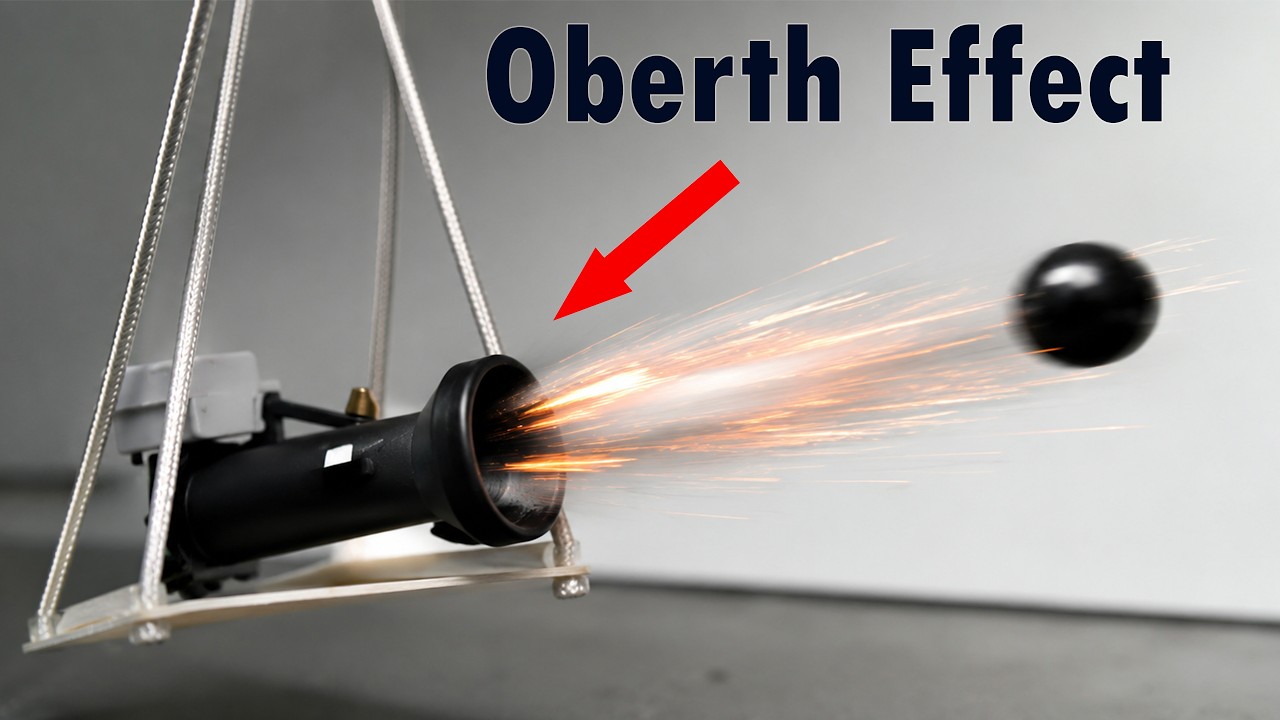
gravity well? Well, yes it did. But since the larger mass or I'll call it a planet is moving, you're being pulled by something that's moving. So gravity also pulls you slightly forward in the direction the planet's traveling. So the gravity well isn't symmetric anymore and you end up gaining momentum in that direction. So this isn't free energy. The energy is taken from the kinetic energy of the moving planet or larger mass and transferred to the smaller mass. All without the two ever touching each other. It works both ways, too. If instead of flying behind the planet's motion, you pass in front of it, then it actually slows you down. So, you can use planets in the solar system to either speed up or slow down, all without burning rocket fuel. Now, gravity assists are incredibly useful, but one of the challenges is that you only gain speed in the direction the planet is moving. Your overall velocity vector gets turned toward that direction. So to use a gravity assist effectively, you have to make sure the planet is in the right position and that you'll end up moving in the direction you want afterwards. Everything has to be timed just right. But when you do, you can theoretically reach double the planet speed relative to the sun. Gravity assist was discovered by a student at UCLA in the 1960s named Michael Minovich while working at NASA doing some early computer simulations of gravity. He discovered that a spacecraft could gain speed just by flying past a moving planet. But at the time, most people assumed gravity could only bend the path, not increase the speed. Since then, gravity assist maneuvers have been used to greatly increase a spacecraft's speed. In theory, the maximum speed you can achieve is twice the planet's orbital speed around the sun. So, wait a minute. The planets are moving fast with the fastest around 47 km/s. If we do this right, we could maybe double that. But the sun itself is orbiting the galaxy at about 220 km/s. So, could we slingshot around the sun and leave the solar system at something like 400 km/s? Well, unfortunately, no. For a gravity assist to work, the object you're using has to be moving relative to you. And we're already moving with the sun, so there's no extra motion there to steal. But that doesn't mean we can't still use the sun's gravity to go really fast. There's another mechanism that uses gravity, but in a completely different way. It's called the Oirth effect. The Oirth effect is the idea that you can gain more energy by firing your rockets when you're already moving really fast compared to when you're moving slowly. This is due to the fact that the faster you move, the more energy is transferred to you versus the fuel you shoot out the back. So, if you fall toward a planet or the sun, you speed up as you go deeper into the gravity well. And if you fire your rockets right at that moment when you're moving the fastest, then you'll get energy gains that scale with speed. So if you're going 10 times faster, you get about 10 times more energy from the same burn. So this means if we do this maneuver near the sun in an elliptical orbit, right at the fastest point of orbit, we kick on the burners, then we can get something like 100 to 200 km/s leaving the solar system. So using these tricks of gravity, we can get to enormous speeds relative to our own sun. And most of that energy came from stealing momentum from other planets or the kinetic energy from our own fuel as we speed up in the oirth maneuver. So who knows, maybe one day we will be able to get out of our own galaxy. And thanks for watching another episode of the action lab and we'll see you next time.