Inside Bangkok’s Aviation Gem: Rare and Unique Aircraft at the Royal Thai Air Force Museum
36:24

Inside Bangkok’s Aviation Gem: Rare and Unique Aircraft at the Royal Thai Air Force Museum

Fly with Magnar 09.05.2026 54 317 просмотров 1 404 лайков

Machine-readable: Markdown · JSON API · Site index

Поделиться Telegram VK Бот
Транскрипт Скачать .md
Анализ с AI
Описание видео
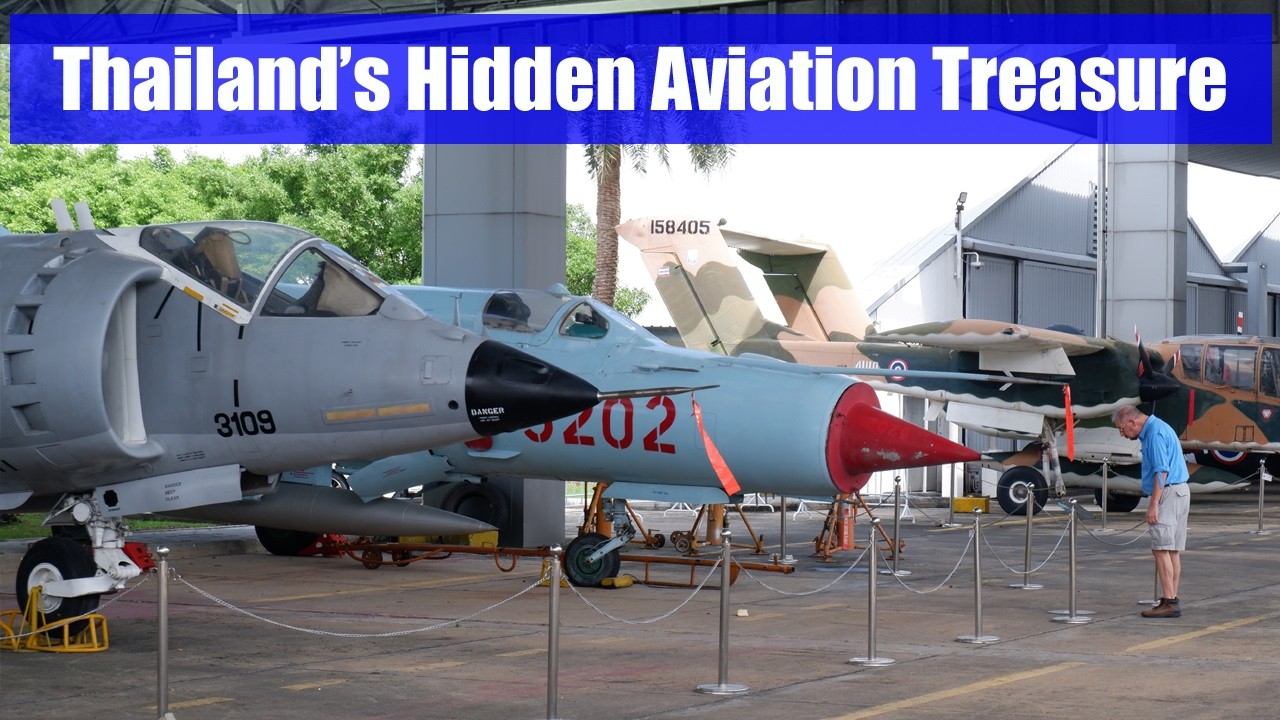
The National Aviation Museum of the Royal Thai Air Force features a collection of approximately 80 aircraft types, representing 50 manufacturers from 15 different countries. Several of these aircraft are unique and cannot be seen anywhere else. The museum is situated on the eastern side of Don Mueang Airport. Admission is free, and it is open daily from 8:00 a.m. to 4:00 p.m., except on public holidays and Royal Thai Armed Forces Day. Getting there is easy: the Skytrain Green Line (Sukhumvit Line) stops right outside the museum, at station N22. Links to videos: The beginning of RTAF: https://youtu.be/Z65JAG_C7Y4 DH.82 Tiger Moth: https://youtu.be/MDxjxgEnVbU Boeing Model 100: https://youtu.be/MojmnT84rAU Flying the Harvard (T-6): https://youtu.be/Guw6TV9_IaM Cessna A-37 Dragonfly: https://youtu.be/zbYRLRjvRlw Northrop F-5 part 1: https://youtu.be/hp53hEYtjxA Northrop F-5 part 2: https://youtu.be/m_cy7_O7wls Northrop F-5 part 3: https://youtu.be/Q01CoL8vUt0 Northrop F-5 part 4: https://youtu.be/6lpC4OB5CvY MiG-21 part 1: https://youtu.be/LjL8HJOxfZ4 MiG-21 part 2: https://youtu.be/yniUgI3EbAM MiG-21 with RCAF: https://youtu.be/unoJCR9MsFY Social Links 🔗 https://www.instagram.com/flywithmagnar/ https://www.facebook.com/groups/flywithmagnar https://www.linkedin.com/in/magnar-nordal/ https://www.youtube.com/@FlywithMagnar "New Moon" 🎵 🎼 Created and produced by Miho Terachi. 🎷 Performed by Miho Terachi (sax) and Marie Takeda (piano). 🎙️ Recorded at Sparkling Studio, Japan. https://www.youtube.com/@TerachiMiho
Оглавление (8 сегментов)

Segment 1 (00:00 - 05:00)

— Hello aviators. How are you today? My name is Magne Nordal and I'm a retired airline captain. Bangkok has been my home for several years and today I'd like to introduce you to a must-visit destination for every aviation enthusiast traveling to Thailand. It's the National Aviation Museum of the Royal Thai Air Force. The museum features a collection of approximately 80 aircraft types representing 50 manufacturers from 15 different countries. Several of these aircraft are unique and cannot be seen anywhere else. The museum is situated on the eastern side of Don Mueang Airport. Admission is free and it's open daily from 8:00 in the morning to 4:00 in the afternoon except on public holidays and Royal Thai Armed Forces Day. Getting there is simple. The skytrain green line or Sukhumvit line stops right outside the museum at station N22. The main building features a permanent exhibition that tells the history of the Royal Thai Air Force. Originally established as the Royal Aeronautical Service in 1914, it operated under army control until 1937 when it became the Royal Siamese Air Force. After Siam was renamed Thailand in 1939, the service adopted its current name, the Royal Thai Air Force. The second hall showcases some of the museum's most valuable and historically significant aircraft. Outside a wide range of aircraft displayed. My photos and videos come from visits spanning from 2009 to 2026. The exhibits are regularly moved and restored. So, each visit offers something new to discover. Visitors will also find a cafeteria and a souvenir shop on site. Now, let's head back to the entrance and take a closer look. As you enter the main building, you are greeted by a Northrop F-5A Freedom Fighter. It served from 1967 to 2000 in three variants, which I will show soon. Notice its distinctive Coca-Cola bottle shape. This design is called area rule and helps reduce drag at speeds close to the speed of sound. The first aircraft in historic exhibition are replicas of the first aircraft used by the Royal Aeronautical Service in 1914. The Nieuport IV C has a few unique features. First of all, there are no ailerons for roll control. Instead, it uses wing warping, where the angle of incidence on the outer wing is adjusted by the pilot. Secondly, there are only two wheels. Between the wheels, there is a wooden skid that has two functions. It protects the aircraft from tipping over its nose. And the off part of the skid is resting on the ground, eliminating the need for a tail skid. The Blériot III is also special. The empennage is hinged and can be moved to control both pitch and yaw. Roll control is achieved by changing the angle of incidence of each of the upper wings. The next room show replicas of the first aircraft designed and built in Thailand. In the background is bomber type 2 Boripat of 1927. And ahead of it is a single-seat fighter derivative, the BK-H5 Prachatipok of 1929. In the next room is the only surviving Vought V-93S Corsair, an export version of the Vought O-3U-6. It is also the oldest surviving aircraft manufactured by Vought Corporation. The Corsair served with the Air Force in two variants, as a trainer and an attacker, between 1934 and 1950. It was used in the Franco-Thai War in 1940-41. A group of Corsairs attacked a French warship and scored one direct hit, but the bomb failed to explode. Next to it stands a Curtiss Hawk III, which was used between 1935 and 1949. This is the last surviving Hawk III. As you understand, this museum is quite unique. The next room has a Grumman F8F-1 Bearcat. This aircraft was designed as an interceptor, and its initial rate of climb was 4,500 ft per minute, give or

Segment 2 (05:00 - 10:00)

take. The Royal Thai Air Force had 207 units in service from 1951 to 1963. Thailand's first jet was the Lockheed T-33A Shooting Star, a trainer developed from America's first operational jet fighter, the Lockheed P-80. The T-33 is fondly known as the T-Bird. It served in Thailand from 1955 to 1996 in two variants. Thailand's first jet fighter was Republic F-84G Thunderjet. A total of 34 aircraft were in service from 1956 to 1963. In the background, you can see a Northrop RF-5A Freedom Fighter, A reconnaissance variant of the F-5 equipped with cameras in the nose. This aircraft was previously displayed outdoors where I took those photos. The final hall houses four aircraft. The first is a Northrop F-5A Freedom Fighter where you can get a close look at one of the cannons. Outside, there's also an instructional airframe that [clears throat] allows you to study the aircraft's internal structure. I have made a few videos about this aircraft. The Northrop F-5B is the two-seat version of the aircraft. Notably, this particular example is the very first F-5B ever built. After completing its test flights in the United States, it was eventually transferred to Thailand where it served for many years. This General Dynamics F-16A Fighting Falcon was retired from service for reasons unknown to me and is now on display in the museum. First flown in 1974, the F-16 remains in production today as the Lockheed Martin F-16V Viper. The final fighter on display is a mock-up of the Saab 39 Gripen presented as a gift from Sweden. The Air Force currently operates the C and D variants introduced in 2011 and have also ordered the newer E and F variants. The exhibition in the second hall changes regularly. Here are the aircraft that were on display during my most recent visit in February 2026. Breguet 14 This aircraft was a true workhorse serving the Air Force from 1919 to 1937. It was license-built in Thailand using Renault engines imported from France. The on display was an error-free replica constructed in France in 1980. It appeared in several films before being transferred to the museum. The replica can be recognized by its two sets of exhaust pipes. The original Renault engine had a single vertical exhaust outlet, but since that engine was not available, the replica was fitted with a Hispano-Suiza V12, which features exhaust ports on both sides. De Havilland DH. 82A Tiger Moth. This well-known training aircraft, designed in 1931, trained thousands of pilots before and during the Second World War. The Royal Thai Air Force operated it from 1951 to 1961. I have flown a Tiger Moth. It was very fun. I have also made a video about this aircraft. Tachikawa Ki-46. It was manufactured in Japan between 1938 and 1944 as an army cooperation aircraft, known for its excellent short-field performance. In December 1941, Japan invaded Thailand. After only a few hours of fighting, the Thai government recognized that a full-scale conflict would be devastating and agreed to a ceasefire. Shortly afterward, Thailand become a formal ally of Japan and the Thai Air Force received Japanese military aircraft, including 24 Ki-36. These aircraft remained in service as trainers until 1950. Of the more than 1,300 units built, only two survive today. The other is preserved at the China Aviation Museum in Beijing. Boeing Model 100E, an export version of the Boeing P-12E. Two aircraft were delivered in 1931 for evaluation. While several P-12 variants still exist, this is the only surviving example of the 100 E. Curtiss Hawk Model 75 N. This was a simplified version of the Curtiss P-36 featuring a fixed landing gear. Thailand ordered 25 aircraft and had received 12 of them by the time Japan invaded the country. Suspended from the ceiling are two rare

Segment 3 (10:00 - 15:00)

gliders. In June 1941, three gliders were presented by Japan as a goodwill gesture. The first is a Nihon Kogata Hato. And the yellow one Tobi. The third glider, now missing, was called Utari. Outside there's a large collection of aircraft that are moved around from time to time. For clarity, I have grouped them according to their roles. In some photos, the aircraft are displayed outdoors while in others they are shown inside. There is an eternal debate over which aircraft is said to be kept indoors, protected from the elements. Next, we come to the helicopter hangar. I am no helicopter expert, but thanks to the information provided by the museum, I can at least pretend I can identify the different types on display. Bell UH-1H Huey. A stretch variant of the classic Vietnam era Huey powered by a 1,400 horsepower Lycoming T53 turbine engine. Bell UH-1N Twin Huey. This version featured two Pratt & Whitney Canada PT6 engines to enhance safety. The decision to use Canadian engines sparked some controversy in United States, but the US Air Force eventually placed an order. A limited number of these aircraft were operated by the Royal Flight in Thailand. Sikorsky UH-19A Chickasaw. This aircraft features a painting of a stork delivering a baby. There is no better illustration of just how useful helicopters can be. Bell OH-13H Sioux. A military version of Bell's iconic Model 47. In 1972, nine were acquired for pilot training before being transferred to the army the following year. The Kawasaki KH-4 was a Japanese built version of the Bell Model 47. These helicopters were transferred from the army to the air force in 1982 and remained service until 1985. Kaman HH-43B Huskie. Intermeshing rotors are cool in many ways. They eliminate the need for a tail rotor allowing more power to be used for lift off and they provide excellent stability in hover. The Royal Thai Air Force operated four of them from 1962 to 1972. This particular aircraft flew numerous missions rescuing down airmen and evacuating wounded soldiers from combat zones. Hiller UH-12B Raven. First flown in 1948, it saw service in both Korea and Vietnam. The Royal Thai Air Force operated five of them from 1950 to 1952. Sikorsky YH-5A. An early helicopter design introduced in 1943. The civilian version was known as the S-51. The air force operated four of them from 1950 to 1954. The Westland WS-51 Mark 1A Dragonfly was a British-built version of the Sikorsky S-51. The Air Force operated three of these helicopters. Bell 206B-3 JetRanger III. Six aircraft were procured in 1995 and used for pilot training until 2006. Sikorsky UH-34D. This workhorse was powered by a 1,525 horsepower Wright Cyclone radial engine mounted in the nose. Sikorsky S-58T. A converted H-34 fitted with a Pratt & Whitney Canada PT6T-3 Twin Pac turboshaft engine rated at 1,800 horsepower. — The Fairchild AU-23A Peacemaker is an American-built version of the Pilatus PC-6 Porter. Equipped with a Garrett turboprop engine and designed for exceptional short takeoff and landing performance. The 1990 film Air America starring Mel Gibson and Robert Downey Jr. was filmed in Thailand and made extensive use of aircraft supplied by the Royal Thai Air Force and the Royal Thai Army. This included four Fairchild C-123 Providers, four AU-23A Peacemakers standing in for PC-6 Porters

Segment 4 (15:00 - 20:00)

several Bell UH-1 Huey helicopters, Bell 206B JetRangers, and Cessna O-1 Bird Dogs. All of these aircraft are preserved at the museum. In one iconic scene, Mel Gibson lands a PC-6 on a hilltop airstrip. The Air Force declined to risk one of its own aircraft, so the filmmakers put together hybrid PC-6 using parts from several older airframes. The Peacemaker remains in service with the Royal Thai Air Force today. Cessna O-1A Bird Dog, an observation aircraft that become well known during the Vietnam War. It served the Royal Thai Air Force on 1967 to 1990. And the museum has two examples on display. Hiller U-10B Courier. This aircraft has an exceptional short field performance. The Royal Thai Air Force operated 20 of them from 1963 to 1986. Beechcraft Model 45 Bonanza. The Royal Thai Navy operated three of these aircraft from 1948 to 1951. The Israel Aircraft Industries IAI Arava is a light transport aircraft designed to operate from short and paved runways. It was produced between 1972 and 1988 with only 103 units built. The Royal Thai Air Force received three aircraft from 1981. Equipped for electronic intelligence gathering, they remained in service until recent years. The Swearingen SA226-AT Merlin IV was operated by the Royal Thai Air Force from the late 1970s until the 2010s. It was fitted with aerial surveillance sensors and specialized equipment for aerial reconnaissance, mapping, and survey missions. Percival Prince 3A, a British postal design first flown in 1948. The Royal Thai Air Force operated one aircraft from 1952 to 1962. It carried out survey work for the mapping organization of the Ministry of Defense. Piper L-4 Cub, also known as the Grasshopper. 44 of these aircraft were used for liaison duties from 1947 to 1962. Stinson L-5 Sentinel, also liaison aircraft, slightly larger than the Piper Cub. The Air Force operated 10 of them from 1947 until 1959. Fairchild Model 24, the Air Force had 13 of them from 1948 to 1950. The Lockheed RT-33A is a reconnaissance variant of the T-33 with a nose section housing several cameras. Although the T-33 is based on the 1944 P-80 design, Thailand continued operating it until 1996. Grumman G-44A Widgeon. Five of those amphibious aircraft were acquired by the Royal Thai Navy in 1951. Later, the aircraft were transferred to the Royal Thai Air Force, who kept them until 1956. Douglas C-47 Skytrain, the military transport version of the DC-3 Dakota. This aircraft is mounted on hydraulic jacks and used as a simulator to entertain visiting school children. The aircraft also has some interesting quirks. Did you know that the windshield wipers are hydraulically operated? The hydraulic lines are known for being leaky, often dripping fluid onto the pilot's shoes. Boeing 737-200, formerly used by the Royal Flight. It has since been replaced by a Boeing 737-800, which is regularly flown by His Majesty the King. Aeritalia G. 222. Thailand operated six of these transport aircraft from 1995 to 2012. Today, the type is known as the Leonardo C-27 Spartan. Beechcraft C-45. This was the military transport version of the popular Beechcraft Model 18, which first flew in 1947. It played a significant role in both commercial aviation and military service, where it was widely used for light transport and aircrew training. Seven examples served with the Royal Thai Air Force from 1951 to 1962. Believe it or not, but the aircraft remained in production until 1970. Fairchild C-123B Provider Another star of the movie Air America

Segment 5 (20:00 - 25:00)

this reliable cargo aircraft was in service from 1964 to 1995. It is also the only aircraft in the museum that visitors are allowed to enter. Government Aircraft Factories N-22B Nomad An Australian light transport aircraft suitable for short unpaved airstrips. It was operated by the Royal Thai Navy from 1982 to 2015. Mikoyan-Gurevich MiG-21bis. It was donated to the museum by the Vietnam People's Air Force in 2014. This aircraft was a real beast in both positive and negative ways. I made a video about it. It has 2. 8 million views, so be sure to check it out. Northrop F-5E Tiger II It was developed from the F-5A, featuring more powerful engines and an onboard radar. Introduced into Royal Thai Air Force service in 1978, the aircraft remains in use today in its upgraded F-5 T H Tigris form. Despite having less powerful engines, the Tiger II proved to be a worthy opponent to the MiG-21. When South Vietnam collapsed in 1975, communist forces captured an air base with several F-5Es and sent one to the Soviet Union for evaluation. Test flights against the MiG-21 revealed, to the surprise of the Russians, that the F-5 was at least equal and in some situations superior in a dogfight. The Americans conducted similar tests and they reached the same conclusion. One key reason is the F-5's better aerodynamics, which allows it to maintain energy more effectively during turning engagements. Supermarine Spitfire Mark 14. This was the best version of the legendary fighter to see service in the Second World War. It could reach a top speed of 720 km/h. German fighter pilots considered it one of the most dangerous opponent during the final stages of the war. Thailand operated the Spitfire from 1951 to 1955. The Spitfire is on my bucket list. North American F-86F Sabre. This fighter gained its reputation during the Korean War when American pilots were engaged in intense dogfights with the equally famous MiG-15. Thailand operated the type from 1961 to 1972. The museum also features an instructional airframe that shows the aircraft's internal structure. North American F-86L Sabre Dog. Developed as an all-weather interceptor variant of the F-86, it was first designated F-95 as it differed substantially from the original Sabre, sharing only about 25% of its components. However, assigning it a new designation would have classified it as an entirely new aircraft program, making funding more difficult to secure. By designating it as an F-86 variant, approval and financing become much easier to obtain. Politics can be a funny game. The RTIF-2 was a training and liaison aircraft developed by the Royal Thai Air Force's Science and Weapon Systems Development Center in 1957. It was derived from the Fuji LM-1 Nikko, itself based on the Beechcraft Bonanza. Only one prototype was built. The Havilland Canada DHC-1 Chipmunk. This little beauty was introduced in 1946 and served in the Royal Thai Air Force from 1950 to 1989. Several Chipmunks are still flying today, and it's definitely on my bucket list. The RTIF-4 Chantra was developed in the early 1970s. Based on the Chipmunk, it featured redesigned cockpit and tail sections. A total of 12 aircraft were built and used as primary trainers from 1974 to 1989. Another unique design, the RTIF-5 was intended as both a trainer and forward air control aircraft. Its layout resembles that of the OV-10 Bronco. Powered by an Allison turboprop engine, only a single prototype was completed, with its first flight taking place in 1984. The Cessna T-37 Tweet, introduced in 1954, served as the primary trainer for two generations of military pilots.

Segment 6 (25:00 - 30:00)

The Royal Thai Air Force began operating it in 1961 and continued until 1996. SIAI Marchetti SF. 260 It's a Frati. Designed by the Italian aeronautical magician, Stelio Frati, this elegant Italian aircraft is often nicknamed the poor man's Spitfire. That's how well it's flying. First flown in 1964, production continued until 2017 with around 900 aircraft built. Thailand retired the type in the early 2000s, but it remains in service with nearly a dozen air forces worldwide where it's used as an aerobatic trainer and light attack aircraft. The RTAF-6 is a development of the SF. 260 built by Thai Aviation Industry. It's powered by an Allison turboprop engine producing 420 horsepower and it entered service in 2017. And it's still a Frati. Rheinflugzeugbau Fan Trainer First flown in 1977, this unique aircraft was designed to give armed forces a trainer with jet-like handling at a low cost. It is powered by a ducted turboprop engine. Despite its promising concept, the Royal Thai Air Force was its only operator using it from 1988 to 1994. Another trainer is the Pilatus PC-9 from Switzerland which served between 1991 and 2023. It's a Swiss hot rod. Basler Turbo Porter PC-2 a two-seat primary trainer developed in the United States. Two aircraft were evaluated by the Royal Thai Air Force in the 1970s, but no further examples were acquired. IAI L-39 set A Albatros was used for weapons training and light attack. The museum has three examples on display. The type was retired in 2021 and replaced by the KAI T-50 Golden Eagle from South Korea. The Albatros remains in production. And I had opportunity to examine the last version, the Skyfox, at the Dubai Airshow last year. North American T-6 Texan This advanced trainer from the 1930s saw more than 15,000 built to train pilots in the United States, Canada, and the United Kingdom during the Second World War. Thailand operated 220 of them from 1948 to 1974. The T-6 is often described as a pilot maker. A few years ago, I had the pleasure of flying one with an experienced display pilot. It is straightforward to fly, but demands respect. If not, it will bite you. Being a relatively heavy taildragger, it is well known for ground looping if you let your guard down. North American T-28D Trojan First flown in 1949, it was designed to replace the T-6 as an advanced trainer. One of its defining features is the powerful Wright R-1820 Cyclone engine. Once you have heard it, you won't forget it. Pacific Aerospace Corporation's CT4 Airtrainer a primary trainer from New Zealand. The Royal Thai Air Force operated 24 of these aircraft from 1999 to 2018. This two-seat Northrop F-5F was delivered to the museum from Singapore. General Dynamics F-16B Fighting Falcon is the two-seat version of the F-16A. — Cessna A-37 Dragonfly or Super Tweet Based on the T-37, it is nearly three times more powerful. It served as a close air support and interdiction aircraft during the Vietnam War. With only one loss to enemy fire during that period. The Dragonfly remains in service in several air forces in Latin and South America. If you want to know more about this aircraft, check out this video. Inside the museum, there is a replica of the bomber type two body pot. The real stuff is displayed outside. The body pot was born out of necessity. In the 1920s, the British Aerospace 14 was licensed built in Thailand. But in 1927, the supply increased the price of the Renault engines. This prompted an effort to explore alternative power plants.

Segment 7 (30:00 - 35:00)

As a result, the body pot was designed to serve as an engine test bed. While also acting as a potential replacement for the British Aerospace 14. The body pot was flown in several different engines, including the Bristol Jupiter the radial BMW 4 V12, Curtiss D-12 and possibly the Pratt & Whitney Wasp. In the end, however, the price of the Renault engine returned to its original level and production of the body pot was discontinued. It is not clear how many were built. One source says more than four, another source claims less than 12. Douglas A-1J Skyraider This aircraft was delivered to the US Navy in 1957. In 1968, it was transferred to the US Air Force and based at Udorn Air Base in Thailand during the Vietnam War. After making a gear-up landing, it was written off and later donated to the museum. The Saab Dornier Alpha Jet A. Thailand received 25 aircraft from Germany in the 2000s. They are used in a light attack role and currently being upgraded to the Alpha Jet TH standard. Fairey Firefly FR. 1 The Firefly served the British Fleet Air Arm during the final stages of the Second World War and later saw service in Australia, Canada, Ethiopia, India, and several European countries and Thailand. The Air Force operated 12 aircraft between 1951 and 1955 in attack and target tug roles. Curtiss SB2C-5 Helldiver This beast of an aircraft had a troublesome development story before it become an effective dive bomber. It was operated by the Royal Thai Navy from 1951 to 1955. Rockwell OV-10C Bronco This aircraft was designed to operate from roads with a wingspan of just 20 ft 6. 1 m. The concept called for two engines, a crew of two, and the ability to carry at least 1,100 kg of cargo or six paratroopers. During development, the weight increased and the wingspan was doubled to 40 ft. Even so, it remained an aircraft with an unusual short wingspan, especially considering it could take off and reach 50 ft in just 850 m from a standing start at maximum takeoff weight. It is also fully aerobatic and capable of operating from aircraft carriers. Legendary test pilot Bob Hoover regularly performed aerobatics, including spins with the aircraft. — Hawker Siddeley AV-8S Matador. The AV-8S was a variant of the British Harrier jump jet built for the Spanish Navy, which later sold them to Thailand in 1997. They operated from Thailand's only aircraft carrier, HTMS Chakri Naruebet, until 2006. LTV A-7E Corsair II. The Corsair II began its career with the US Navy as an all-weather attack aircraft equipped with advanced avionics. It was the first American aircraft to feature a head-up display. The Royal Thai Navy operated 21 Corsairs between 1995 and 2007, though they never operated it from the aircraft carrier. And that concludes the tour of the National Aviation Museum of the Royal Thai Air Force at Don Mueang Airport in Bangkok, Thailand. I hope you enjoyed it. If there's a particular aircraft you'd like to learn more about, feel free to leave a comment below. As always, a big thank you to the supporters of this channel who make this content possible. Thank you for watching. Have a wonderful day and happy learning. Auto throttle 1. 5 — Do you want to Yeah. Mhm. That's all we need to do 600 bucks. Uh negative. 2600 here. —

Segment 8 (35:00 - 36:00)

— It's on. —

Другие видео автора — Fly with Magnar

Ctrl+V

Экстракт Знаний в Telegram

Экстракты и дистилляты из лучших YouTube-каналов — сразу после публикации.

Подписаться

Дайджест Экстрактов

Лучшие методички за неделю — каждый понедельник