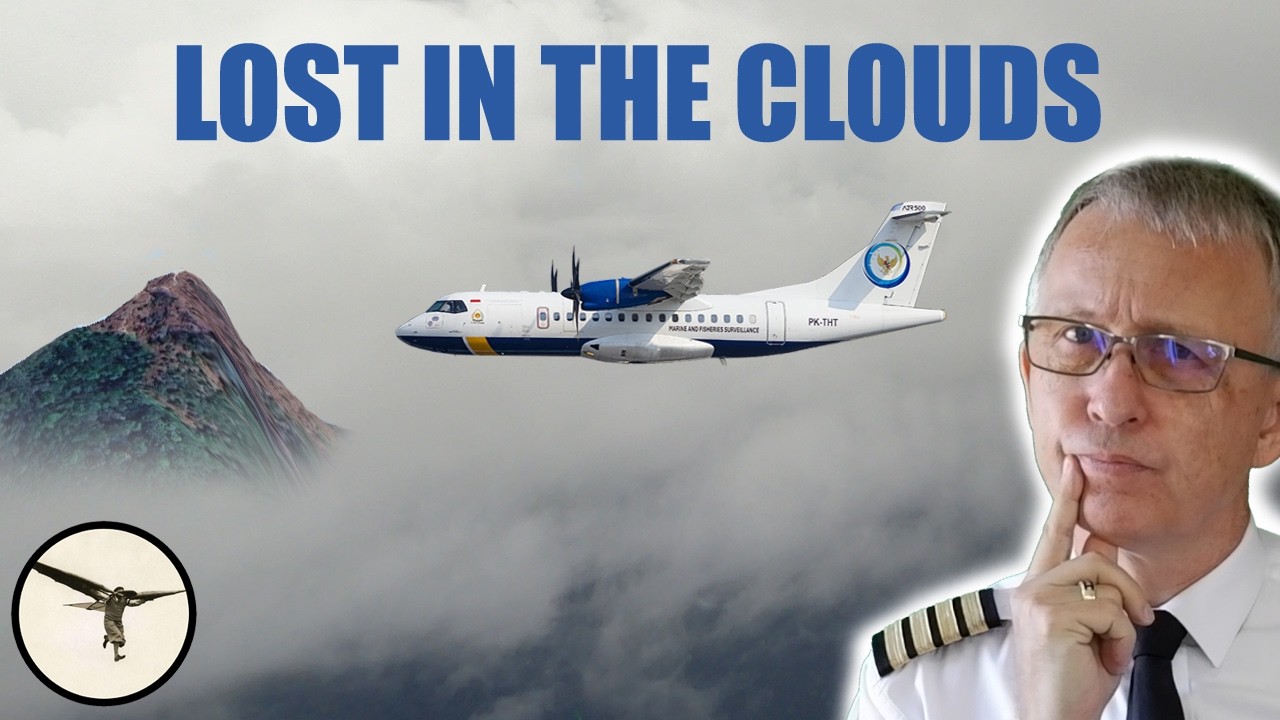
On 17 January 2026, an ATR 42-500 operated by Indonesia Air Transport crashed into a mountain during its approach to Sultan Hasanuddin International Airport in Makassar in Indonesia. The preliminary report is released, confirming that aviation accidents seldom stem from a single cause. Hello aviators, how are you today? My name is Magnar Nordal. I’m an ATR instructor and a retired captain. Almost every aviation accident is the result of a chain of events that was allowed to unfold. Often, several contributing factors align — perhaps four separate elements — and together they lead to disaster. Remove just one of those factors, and the accident might have been prevented. This may well be the case in the accident involving the ATR 42-500 operated by Indonesia Air Transport. The aircraft, registration PK-THT, had been chartered by the Indonesia Ministry of Marine Affairs and Fisheries. There were ten people on board: Two pilots, two flight attendants, one flight operations officer, two aircraft engineers, and three aerial surveyors. According to the flight plan, the crew was scheduled to conduct surveillance over four designated areas, as shown on the map. They would depart from Yogyakarta, and the final destination was Makassar. After engine start, the Flight Data Recorder (FDR) captured a degraded signal from the aircraft’s Global Navigation Satellite System (GNSS). On the ATR, the GNSS consists of a GPS satellite antenna, a Navigation Processor Unit, and a Multi-function Control Display Unit (MCDU). The MCDU, located on the pedestal between the pilots, allows them to enter and modify the flight plan, which the autopilot can then follow. The system determines the aircraft’s position using signals from GPS satellites, supplemented by ground-based radio navigation aids such as VOR and DME. The calculated position and flight plan are displayed on the Electronic Horizontal Situation Indicator (EHSI). In addition, the aircraft’s position is transmitted via a separate VHF frequency through a system known as Automatic Dependent Surveillance – Broadcast (ADS-B). This enables air traffic controllers to monitor aircraft on their screens, even in areas without radar coverage. Where radar coverage exists, the radar position is cross-checked against the ADS-B data, and if there is any discrepancy between the two sources, the system alerts the air traffic controller. If the GNSS is unable to determine an accurate position—for example, due to loss of GPS signal—it will notify the pilots through indications on both the MCDU and the EHSI. On this particular flight, the FDR recorded a GNSS “Degrade” signal shortly after engine start. This would appear as an amber “DGR” annunciation on the EHSI and the message “UNABLE RNP” on the MCDU. In practical terms, this meant that the required navigation performance could not be met, and the GNSS should not have been used for navigation. It remains unclear whether the pilots noticed the message on the MCDU, or whether it was cleared without fully recognizing its significance. The Cockpit Voice Recorder (CVR) had a recording capacity of two hours. Since the flight lasted more than three hours, the initial portion of the flight—including the engine start phase—had already been overwritten. The aircraft departed Yogyakarta at 01:09 UTC (08:09 local time). To avoid confusion, I will use UTC, as the flight crossed a time zone during the mission. As the aircraft climbed through 5,900 feet, the ADS-B ground station began receiving position reports. At that moment, the position transmitted via ADS-B differed by 0. 6 nautical miles (NM) from the position recorded by the Flight Data Recorder (FDR). On the chart, this period—when the GNSS was operating in Degrade mode—is shown as a red line. When the aircraft passed 7,700 feet
Segment 2 (05:00 - 10:00)
the GNSS Degrade alert disappeared. A few minutes later, the position recorded by the FDR and the position transmitted through ADS-B matched exactly. On the chart, this phase is indicated in yellow. At 01:17 UTC, the aircraft levelled off at its cruising altitude of 11,000 feet. At 01:43 UTC, the GNSS entered Degrade mode once again—and this time, it remained in that condition for the rest of the flight. From that point onward, the FDR-recorded position and the ADS-B transmitted position began to diverge. By the end of the flight, the difference had grown to approximately 15 nautical miles, or 28 kilometers. At first glance, it may seem impossible for GNSS and ADS-B to show different positions, since both rely on GPS data. However, ADS-B does not simply retransmit the same GNSS position that is recorded by the FDR. The GNSS position is logged by the FDR, but ADS-B processes and transmits position data through its own system architecture. Somewhere within the electronic circuitry or software logic, an error occurred. Without reliable GPS input—and operating far from ground-based navigation stations—the GNSS reverted to Dead Reckoning navigation. This is one of the oldest navigation methods, where position is estimated based on heading, airspeed, wind direction, and wind velocity. Any change of those parameterns requires corrective adjustments. If those adjustments are not accurate, the calculated position will gradually drift away from the aircraft’s true position. That is precisely what happened here. On the chart, the red line represents the position recorded by the FDR, while the white line shows the position transmitted by ADS-B. When the aircraft reached the designated survey areas, it descended to altitudes as low as 1,500 feet. At these lower altitudes—especially over the ocean—the ADS-B ground stations were unable to receive the transmitted signals consistently, due to limited coverage. At 03:48 UTC, the copilot—acting as Pilot Monitoring (PM)—established initial contact with the Air Traffic Controller at Ujung Pandang Terminal Control Area (TMA). After radar identification, the PM informed the controller that the aircraft would proceed to the final aerial surveillance area, located 63 nautical miles (NM) from the destination airport. At that moment, there was a 14 NM difference between the aircraft’s position as recorded by the FDR (and displayed to the crew on the EHSI) and the position transmitted via ADS-B (and displayed to the controller). In other words, the crew’s mental picture of their position differed from their actual location. At 03:49 UTC, the PM reported, “We are now heading 090 about 13 miles ahead,” and requested a Standard Arrival (STAR). The controller advised them to expect a left turn direct to waypoint DAKAD. At 04:01 UTC, the controller asked the aircraft to report its heading. The PM replied that they were on heading 083° toward DAKAD at 6,000 feet. However, FDR data showed the aircraft was about 10 NM west of DAKAD, while ADS-B data indicated it was about 17 NM southwest of DAKAD—a discrepancy of approximately 15 NM. Meanwhile, the crew continued their approach preparations, including completing the approach checklist. At 04:03 UTC, the controller contacted the aircraft again. The PM reported they were tracking to DAKAD on heading 083, about 0. 9 NM from the waypoint. In reality, FDR data showed the aircraft was about 1 NM west of DAKAD, while ADS-B showed it approximately 15 NM southeast of DAKAD. At 04:03 UTC, the controller attempted to alert the crew to the position discrepancy using the phrase, “DAKAD you’re not, not point,” and instructed a left turn to heading 360 for sequencing. The phraseology was unclear, and it is doubtful the pilots fully understood the controller’s concern. According to the preliminary report, both pilots and the controller held ICAO English language proficiency Level 4—the minimum acceptable standard. While their
Segment 3 (10:00 - 15:00)
English proficiency may have been limited, all were Indonesian nationals and could have switched to their native language to clarify critical information. At 04:05 UTC, the PM requested a turn to heading 020 to avoid weather. The controller approved the request. At 04:10:00 UTC, the PM advised they were ready to turn right. The controller instructed the aircraft to turn right direct to waypoint ARAJA, maintain 6,000 feet, and cleared them for an ILS approach to Runway 21. The PM requested a left turn instead due to weather. At 04:10:22 UTC, the controller denied the left turn due to conflicting traffic at 6,000 feet and instructed the aircraft to descend to 5,000 feet. The PM correctly read back the descent and traffic information. When the controller observed the aircraft turning left on the display, he repeated that a left turn was not possible. The PM then stated they would turn right on heading 020. This placed both crew and controller in a challenging situation. Pilots naturally avoid weather cells displayed in red on the weather radar screen, while controllers must provide safe separation between aircraft. At 04:11 UTC, the controller instructed a left turn direct to waypoint ARAJA and again cleared the flight for the ILS approach to Runway 21. The PM acknowledged. Shortly afterward, the controller noticed the aircraft was not tracking toward ARAJA. At 04:16 UTC, he instructed, “Vector to OPENG, turn left heading 125. ” The PM read back, “Turn left heading 125. ” At 04:20:04 UTC, the controller’s display showed the aircraft at 5,000 feet entering an area where the minimum safe altitude was 8,000 feet. Critically, Warning (MSAW) system did not activate. The MSAW is designed as a last line of defence if both pilots and controllers lose situational awareness. Why it failed to activate remains unknown and will likely only be clarified in the final investigation report. By this point, the situation had become critical. The aircraft was operating in mountainous terrain, the crew’s perceived position differed significantly from reality, and the controller appeared unaware of the immediate terrain threat. At 04:20:46 UTC, the PM reported maintaining heading 125 at 5,000 feet. The controller instructed a right turn direct to waypoint KABIB. The PM acknowledged and asked whether to maintain 5,000 feet. The controller then instructed them to descent to 3,200 feet and direct KABIB to intercept the ILS. At 04:22:24 UTC, the controller observed that the aircraft was not tracking toward KABIB and instructed a right turn to proceed to final. The PM replied that they were heading to KABIB. At this moment, FDR data showed the aircraft approximately 16 NM northeast of KABIB, while ADS-B showed it about 6 NM east of KABIB. At 04:22:36 UTC, the controller advised that the aircraft had passed KABIB and asked whether they were turning right to heading 245 to intercept final for Runway 21. Seconds later, the display showed the aircraft was descending through 4,100 feet into an area where the minimum safe altitude was 6,000 feet. Once again, the MSAW did not activate. At 04:22:45 UTC, the PM confirmed they were turning right to heading 245. Moments later, the Ground Proximity Warning System (GPWS) issued the aural warnings: “TERRAIN, TERRAIN,” followed by four successive “PULL UP” alerts. Shortly thereafter, the Cockpit Voice Recorder stopped recording. The aircraft struck the crest of a mountain ridge at approximately 4,300 feet elevation. The wreckage came to rest on the far side of the ridge. Rain, fog, steep terrain, and slippery vegetation severely hampered rescue efforts. When the wreckage was finally located, there were no survivors.
Segment 4 (15:00 - 17:00)
When we examine the chain of events, several contributing factors become apparent: 1) A technical failure in the aircraft’s GNSS. 2) The crew’s apparent failure to effectively respond to that malfunction. 3) A failure of the Minimum Safe Altitude Warning (MSAW) system, which should have alerted the controller. 4) And—speaking cautiously—the preliminary report suggests that the controller may have had opportunities to provide clearer or stronger warnings about the high terrain ahead. There may well be additional contributing factors that are not yet known. Determining those is the responsibility of the accident investigators. What is clear, however, is that this accident resulted from a chain of events. Had just one link in that chain been removed, the outcome might have been different. That is the core principle of aviation safety. Technical failures do occur. Human errors do occur. The goal is not to pretend they won’t happen—but to design systems that prevent such errors and failures from aligning into a catastrophe. We do this through system redundancy, clear regulations, robust procedures, effective training, and strong airmanship. That is all for this time. As usual, a big thank you to the supporters of this channel who make this content possible. Thank you for watching.