How to Clone Clothes (Demonstrated on an Edwardian Corset)

How to Clone Clothes (Demonstrated on an Edwardian Corset)

Machine-readable: Markdown · JSON API · Site index

Поделиться Telegram VK Бот
Транскрипт Скачать .md
Анализ с AI

Оглавление (4 сегментов)

Segment 1 (00:00 - 05:00)

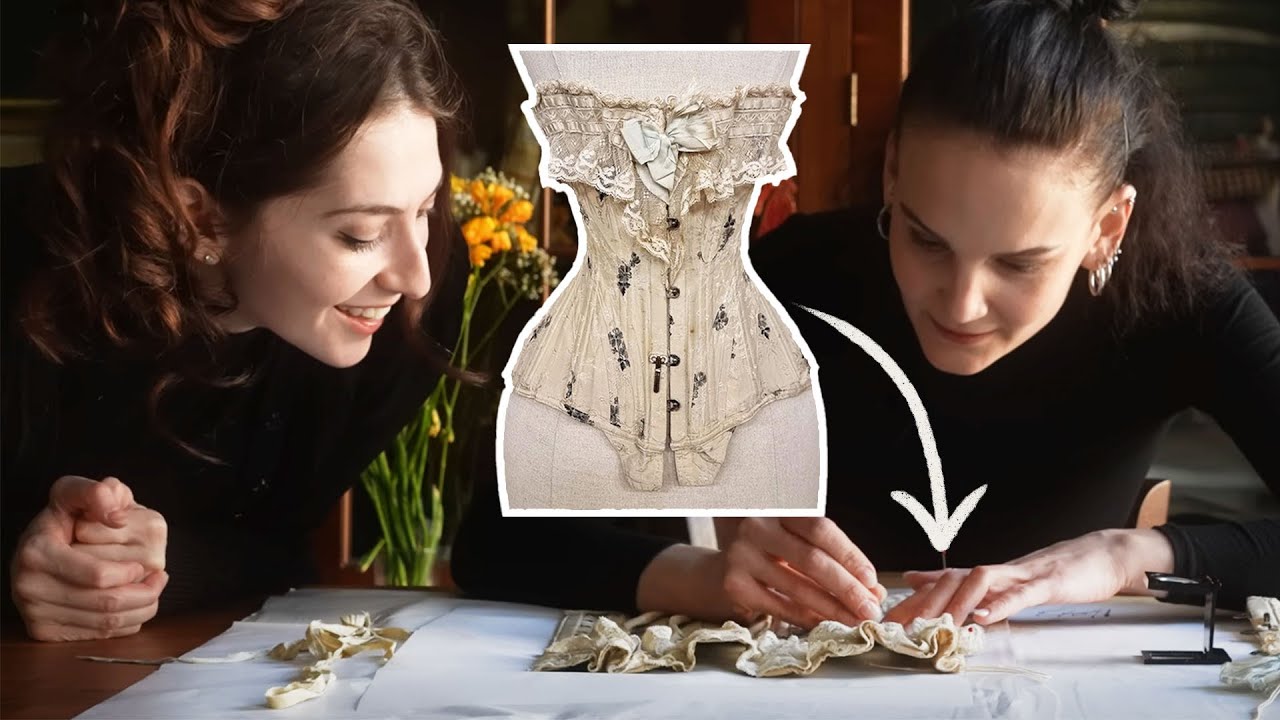
Learning how to take a pattern from your own clothes is such a powerful hack. Whether you're just a humble clothes wearer wanting to replace your favorite jacket with an exact copy, or you're a vintage or antique clothing enthusiast who wants to be able to wear fragile or shattered old styles brand new, my Taylor pal, Barbara of Royal Black Couture, has a non-destructive way of lifting patterns that I really wanted to show you today. — Wait, that's genius. It's like you wouldn't look at this and think this is definitely a corset. — Yeah. — Barbara is going to be demonstrating this on an antique Edwwardian corset, but this technique can be applied to any garment, new or old. So, your favorite jacket or dress can be duplicated and remade in different colors and fabrics. The possibilities are endless. What I've brought here with me is a really beautiful antique corset. I just fell in love with the elegant lines and all the engineering that has gone into creating these patterns. On Sband corsets, the panels go in this diagonal swooping seam lines all around the body. And the bon channels, they are actually stitched straight through the panels. So they are not following the seams. We can also see that there are these facets inserted. And I just really love how these lines curve around the body. It's only one layer of very thin silk that was densely woven to make it extra strong and still looks incredibly beautiful and decorative. What you can see here, it's presented on acidfree tissue paper to protect the garment. We've laid it out like this, making sure it's not bent or creased or folded anywhere. We have to take a moment to discuss currently accepted good practice methods of conservation and handling antique garments. Not because I expect most of you out there will be patterning your local 18th century stays. But for those keyboard warriors who mean so well, but actually end up spreading outdated or misinformed handling practices. Okay. No, we are not wearing gloves when handling antiques. We do need to be working with clean hands, sands, lotions, or nail polishes or sweat. But conservationists currently believe that having a barrier between your sense of touch and the antique garment actually causes more damage because you can't feel precisely where you are and how anything fragile might be behaving. So, clean dry hands only. Here you can see the original lacing. It has already dissolved. I don't mind that it's in that state because I don't lace it on a dress form or on the body because it would put so much strain on the material on the fibers. It's also super important to store them in the correct way. What should be avoided is direct sunlight, moisture. I recommend either laying it flat in a box in either acidfree tissue paper or something like old bed sheets would also work well. Lying it flat or gently rolling it over. That is the most gentle method of storing it. So what we would like to show you now is how to take a pattern from an antique garment. For a while, I was under the impression that in order to get a pattern from a garment, either you had to completely unpick the whole thing to trace each individual piece, or you had to spend days painstakingly plotting out each piece by counting threads in the weave. And to be fair, that is still how extremely precise patterns like the ones seen in patterns of fashion are done. But Barbara has a much simpler, non-destructive way of lifting patterns, and it's definitely something that I plan to use for myself in future. We have a few special tools and items. There are these really fine insect pins. They are almost invisible. You can put them through the fibers without damaging the fibers. Insect pins are those super fine pins. Those pins that enmologists use to stick butterflies to the wall. They're really bendy, really flexible, really fine, and they're like half the width of dress pins. Definitely don't put those in an antique garment. But let me be super clear. Fine insect pins will not harm an antique garment and are currently accepted practice in archival and conservation. Marking grain lines and measuring points when taking patterns does really help to get the most accurate pattern possible. And if a couple of insect pins and an accurate pattern save the garment from having to be brought out and referenced by three dozen costume makers in future, that is a whole lot of wear saved. We have a thread counter. So you use this to count the amount of threads in each section of a panel. And that way you can very

Segment 2 (05:00 - 10:00)

accurately reproduce how wide a panel is by using the number of threads. And then I have this tracing paper and that helps directly transfer the panel from the garment onto the paper. I will also put some cardboard underneath my acetry tissue paper and then we are all ready. So when taking a pattern I always start with the panels that are the easiest like the center front panel because the center front is completely straight on almost every garment and we can just start with a straight line. And now I use one of these very fine insect pins and very carefully go all the way here to the seam and stick the pin through one of the existing holes of the seam. That way I don't create any new holes in the fabric. I use the existing hole of the seam and transfer it to the paper underneath. Of course, this can only be done in between the bones. The seams that go over bones, they have to recreate it with measuring later on. — Oh, wow. Wait, so you're puncturing holes onto the tracing paper? — Yes. I'm not uh creating new holes at all. So, I'm puncturing through the seams and then I have the holes in the paper and can connect them. Right. Wait, that's genius. I secure this middle area that lies completely flat and smooth on the table so it can't shift. And now I move on to these areas that are a little bit distorted from the bon and the other panels. And I very gently pull it into a flat position. And then I can continue with the pin and to trace more of the panel very carefully that I don't create new holes but just follow the existing holes of the seam. And down here at the bottom edge I also trace the edge of the corset with little pin pricks. It gets a bit more tricky up here because we have all of these extra widths that is in folds. We have to smooth that out. And now I can start by tracing the top edge. Now we have the first panel and we can take a look. The little dots are almost invisible, but the paper shows them off and we can trace them to get an approximate shape and then seeing if it needs to be corrected anywhere. — That is so fast. Yeah. I'm not sure if it's the most accurate. Um, — it's a great accessible method for people to do at home. It's not like you're doing patterns of fashion. — Yeah. — So, now we have the roughly traced shape. You can already see the beautiful diagonal seam lines here. And what I would do now is to take measurements of the panel and compare it with my pattern to make sure that it's as close to the original garment as possible. And I do that every 2 cm or so. I'm basically creating a grid and transferred measurements from the garment onto the paper. My traced line is quite close, but I still correct the lines so it's more accurate. Now we can start drawing in the details. The front bask I just transfer by measuring 1. 4 4 cm width for the front pusk. And I draw that in. And now we move on to the bone casings by measuring from the bottom edge to the seam of the bon channel. And then I transfer that measurement. And then I can connect them in a straight line and have my first bon channel. The following ones are much easier because we can just measure the

Segment 3 (10:00 - 15:00)

width of them. I would say we go for 8 mm wide bon channels. That seems to be the average here. The only thing that is still missing is the waist tape and the hook and eye part of the front closure. And I determine the position of that both by measuring. go from the bottom edge and transferring that measurement to the paper. Then going from the seam of the panel along the bon channel and measuring and transferring. Now we can measure the width of the waist tape and then drawing it in. Now I'm transferring the knobs of the front busk and then double check by measuring the other panels that are not the center front. We have to also take a look at the grain line and the pin helps you to follow the grain line to find it on the panel. So we have marked the grain line with a row of dots. And now we can repeat the steps tracing the seam lines on these panels. I find it easier to also trace the bon channels with the pin because there are not that many straight lines that I can use as a reference for measuring. And that's why I trace the bon channels with the pin as well. And now we have the basel and we can move on to all the other panels of this wonderful piece here. — Wow. That is that is insane, right? — That is insane. It's like you wouldn't look at this and think this is definitely a corset. — Yeah. — What we see here are the traced panels onto new paper and cut them out. But I left extra paper along the bottom edge and along the top edge. So now we can tape these panels together and refine the top and bottom edge into a nice curve and make sure that the bon channels are going in smooth lines from one panel into the other. — This already creates such an increase. — I know, right? — So now we have a paper mock up of our corset. It already gives us a good idea how everything goes together. And what we can do now is to refine the bottom and top edges. There are some areas like here where it needs to be evened out. And also here we have this little bump that we can correct. And here we have a difference in length which also should be evened out. That is our bottom edge. Wow. And now we just cut off the excess and have our finished panels. What we can do now is correcting the bon channels because they are not completely aligned throughout the panels. The easiest way to trace them and refine them like this when the pattern is assembled.

Segment 4 (15:00 - 16:00)

We can actually cut it apart. Then the bony channels and lines will stay on the pattern. — It's like this is what we mean when we say like corsets were engineered over centuries and it's all in the cutting. Yeah, it's the shape. — I mean, look at that. It's magic. — Barbara has very kindly made her pattern available to download if you are interested in having this Edwwardian corset a go for yourself. We'll have the link to her store where you can find loads of her incredible patterns and tutorials down in the description box below. And if you would like to support these sorts of videos where I bring you some expert guest knowledge for us both to learn from, consider joining us on Patreon because I never expect anyone I work with to go uncompensated for their knowledge. I am actually also in the process of developing some patterns of previous projects myself and our community over there has been such a help. You can even join as a free member which is absolutely no cost to you. But Patreon is just the best place for me to be able to write text posts and to really keep people up to date directly. We are actually going to meet some pattern testers in the future, as well as some opinions on which patterns to prioritize. So, if you'd like, join the party over there. That's all for now.

Другие видео автора — Bernadette Banner

Ctrl+V

Экстракт Знаний в Telegram

Экстракты и дистилляты из лучших YouTube-каналов — сразу после публикации.

Подписаться

Дайджест Экстрактов

Лучшие методички за неделю — каждый понедельник